
Michigan Cannabis Retail Market Update — March 2026
Michigan cannabis retail operators entered March 2026 facing competing forces: nearly $93.7 million in adult-use excise tax revenue distributed to 313 government entities and tribes, a state senator’s bill to repeal the 24% wholesale tax that took effect January 1, and New Buffalo Township’s move to revoke licenses retroactive to early 2025. January sales dropped 16% month-over-month and 8% year-over-year to $226 million, while the combined tax burden hit 40%. The legislative and enforcement landscape is shifting fast, with direct implications for margins, compliance risk, and local operating authority.
Top Headlines This Month
- 💰 $93.7 million tax distribution confirmed, per-license share drops to $54,017
- 📋 Senator Lindsey files SB 810 to repeal 24% wholesale cannabis tax
- 🏛️ New Buffalo Township adopts retroactive license revocation policy
- 📊 January 2026 sales fall 16% month-over-month, down to $226 million
- ⚖️ Michigan Supreme Court to hear two cases on licensing transparency and MRTMA probation
💰 Statewide: $93.7 Million Tax Distribution Shows Per-License Decline
The Michigan Department of Treasury distributed nearly $93.7 million in adult-use excise tax revenue for fiscal year 2025 to 313 government entities and tribes. Wayne County and the City of Detroit received the largest shares. The per-license distribution dropped to $54,017.10, down from $58,228.66 in FY 2024, reflecting tighter margins across the state’s $3 billion cannabis industry. Total sales fell $100 million year-over-year.
The declining per-license payout signals that revenue growth is not keeping pace with license expansion. As more municipalities opt in and more retailers open, the share available to each jurisdiction shrinks. Operators should expect continued municipal scrutiny on tax contributions and local economic impact, especially in jurisdictions where cannabis retail was sold as a revenue driver. The $100 million sales decline adds pressure to an already competitive Michigan cannabis market where pricing and product mix are under constant adjustment.
📋 Statewide: Senator Lindsey Introduces Bill to Repeal 24% Wholesale Tax
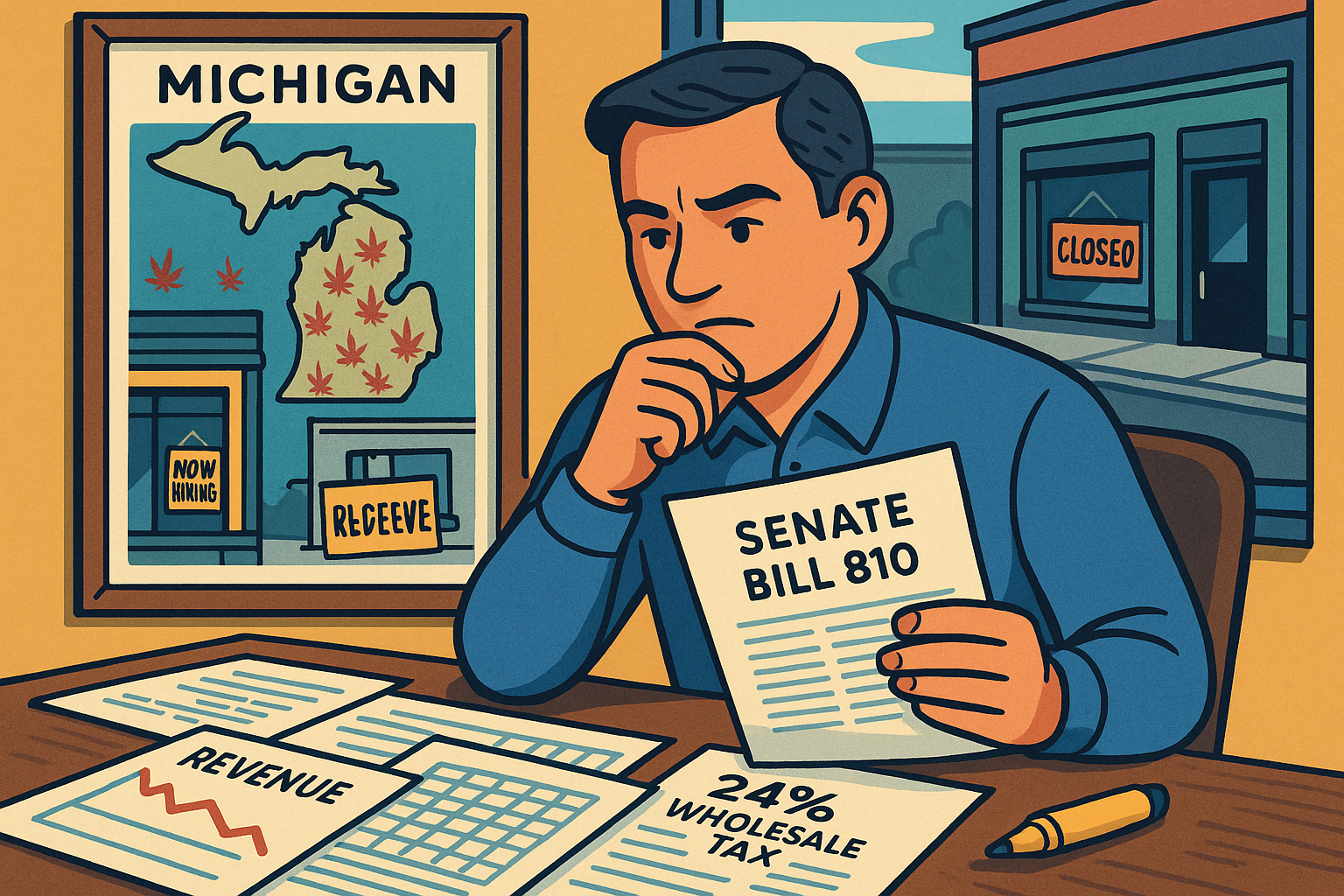
State Senator Jonathan Lindsey filed Senate Bill 810 on February 26, 2026, to repeal the 24% wholesale cannabis tax that took effect January 1. The tax was approved by lawmakers in October 2025 and stacked on top of the existing 10% excise tax and 6% sales tax, creating a combined 40% burden. Industry stakeholders report a 16% drop in cannabis business since implementation, with facility closures, layoffs, and a shift of consumers to the illicit market. The state had projected $420 million annually from the wholesale tax to fund roads.
If SB 810 advances, the total tax burden would drop from 40% back to 16%, materially improving retail margins and pricing flexibility. The bill’s introduction signals legislative recognition that the January tax increase pushed too hard, too fast. Retailers operating on thin margins and competing with illicit operators should monitor committee assignments and hearing schedules closely. The tax repeal debate will define Michigan cannabis retail economics for the next 12 to 24 months.
🏛️ New Buffalo Township: Retroactive License Revocation Policy Adopted
The New Buffalo Township Board adopted a policy in late February 2026 to potentially revoke special land use permits for dispensaries violating state law, Cannabis Regulatory Agency rules, township ordinances, or endangering public health. The policy is retroactive to January 1, 2025. Public hearings are scheduled for March 24, 2026, for five dispensaries, including Bloomery Cannabis, Mint Cannabis, The Refinery Dispensary New Buffalo, The Plug New Buffalo, and Trap Stars Outlet. The township has 29 operating dispensaries serving a population of 2,500 residents, with a half-dozen more set to open in 2026.
The retroactive effective date and rapid hearing schedule create immediate compliance risk for New Buffalo operators. Township officials cited information from the Cannabis Regulatory Agency as the basis for potential violations. Retailers in high-density markets should review their own local ordinances for similar revocation language and confirm that all state and local reporting, zoning, and operational requirements are current. New Buffalo’s aggressive stance may set a precedent for other small townships facing dispensary saturation and resident pushback.
📊 Statewide: January 2026 Sales Drop 16% Month-Over-Month
Michigan recreational cannabis sales fell nearly 16% in January 2026 compared to December 2025, and were down 8% year-over-year to $226 million. The decline followed the January 1 implementation of the 24% wholesale tax, which added to pricing pressure and drove some consumers to the illicit market. Industry representatives cited facility closures, mass layoffs, and loss of employee benefits as immediate consequences of the tax increase and sales contraction.
The January 2026 sales dip is the clearest signal yet that Michigan cannabis retail is in a margin-compression cycle. Operators relying on volume growth to offset rising taxes and operating costs face a shrinking revenue base. The combined effect of the 40% tax burden and consumer sensitivity to price is pushing buyers toward unlicensed sources or reducing purchase frequency. Retailers should model cash flow scenarios assuming flat or declining sales through Q2 2026, especially if the wholesale tax repeal bill stalls in committee.
⚖️ Statewide: Supreme Court to Hear Licensing Transparency and MRTMA Probation Cases
The Michigan Supreme Court scheduled oral arguments for March 10–12, 2026, in two cases with direct implications for cannabis retail. In People v. Hess, the court will address whether mandatory probation conditions can bar MRTMA-compliant marijuana use and under what circumstances courts may impose such restrictions. In Exclusive Capital Partners v. City of Royal Oak, the court will determine whether a city manager selecting cannabis retail applicants must comply with the Open Meetings Act. The Court of Appeals previously found an OMA violation in the Royal Oak case, where the city manager chose two applicants from 31 without a public process.
The Royal Oak case could establish a statewide precedent requiring municipalities to conduct cannabis retail licensing decisions in public-facing forums with agendas, deliberations, and records subject to OMA transparency rules. If the court rules in favor of the plaintiffs, rejected applicants in other jurisdictions may challenge closed-door selection processes. The Hess case could clarify workforce and compliance policies around MRTMA-compliant use, affecting hiring practices and employee handbooks. Both rulings are expected to shape Michigan cannabis retail regulatory frameworks through 2026 and beyond.
The Bottom Line
Michigan cannabis retail in March 2026 is defined by tax pressure, enforcement escalation, and sales contraction. The $93.7 million tax distribution and declining per-license share confirm that revenue growth is not keeping pace with retail expansion. Senator Lindsey’s SB 810 to repeal the 24% wholesale tax offers potential relief, but the timeline remains uncertain. New Buffalo Township’s retroactive revocation policy and March 24 hearings signal a new phase of local enforcement tied to state CRA actions. January 2026 sales dropped 16% month-over-month to $226 million, reflecting consumer sensitivity to the 40% combined tax burden and increased competition from the illicit market. Operators should monitor the legislative calendar for SB 810 movement, review local ordinances for revocation language, and model cash flow scenarios assuming flat or declining sales through Q2 2026.
📬 Get Monthly Market Updates
Stay ahead of the curve with our monthly cannabis retail market newsletter. New markets, regulatory changes, and expansion opportunities delivered to your inbox.