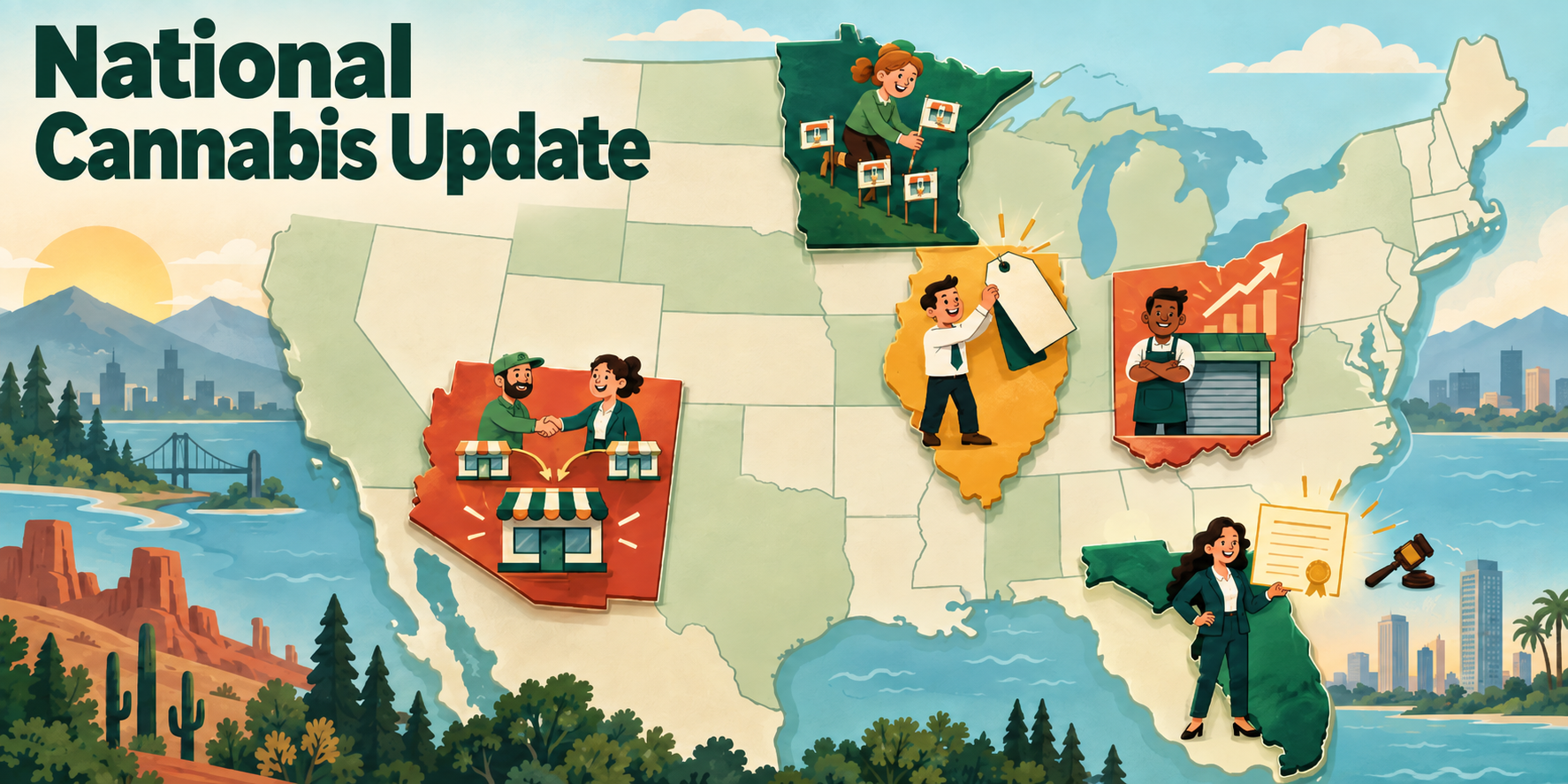
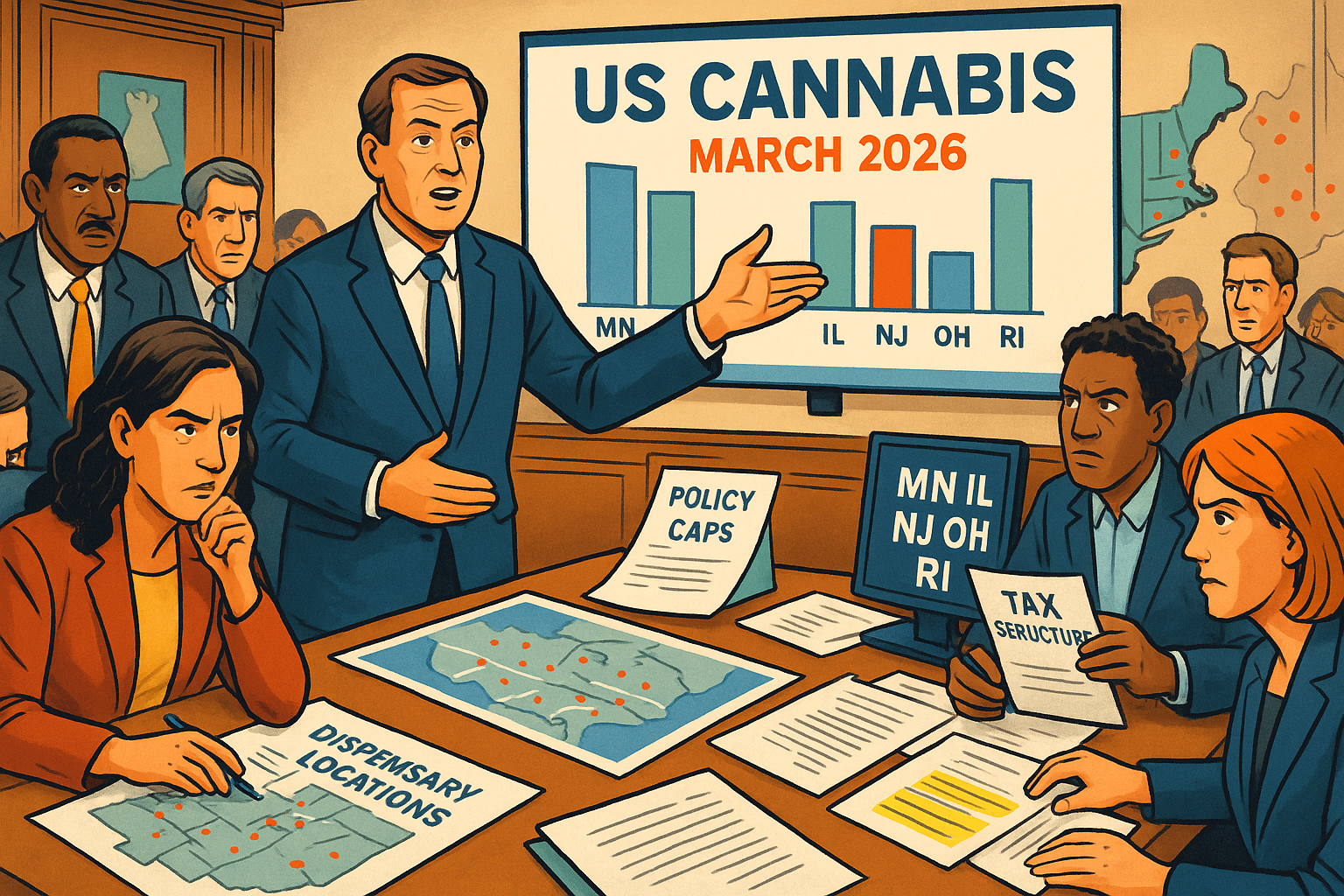
March 2026 delivered pivotal moments for cannabis state programs across the country. Minnesota rolled out craft cannabis products statewide for the first time, Rhode Island’s planned 20-license lottery hit federal constitutional scrutiny when a judge ruled the dormant commerce clause applies to state cannabis frameworks, and Ohio operators faced a March 20 deadline when the newly imposed 400-dispensary cap would take effect after referendum efforts failed. Meanwhile, New Jersey saw aggressive CRC enforcement with license suspensions and product holds, and Illinois grappled with a 12% year-over-year sales decline to $1.5 billion as neighboring states captured market share. These state-level developments signal where the national cannabis retail landscape is headed next.
Top Headlines This Month
- 📋 Minnesota craft cannabis products hit dispensary shelves statewide
- ⚖️ Rhode Island federal court applies commerce clause to cannabis licensing
- 🗳️ Ohio 400-dispensary cap takes effect March 20 after failed referendum
- 🏛️ New Jersey CRC suspends licenses, intensifies state enforcement
- 📊 Illinois cannabis state sales drop 12% to $1.5 billion
📋 Minnesota: Craft Cannabis Products Launch Statewide in March
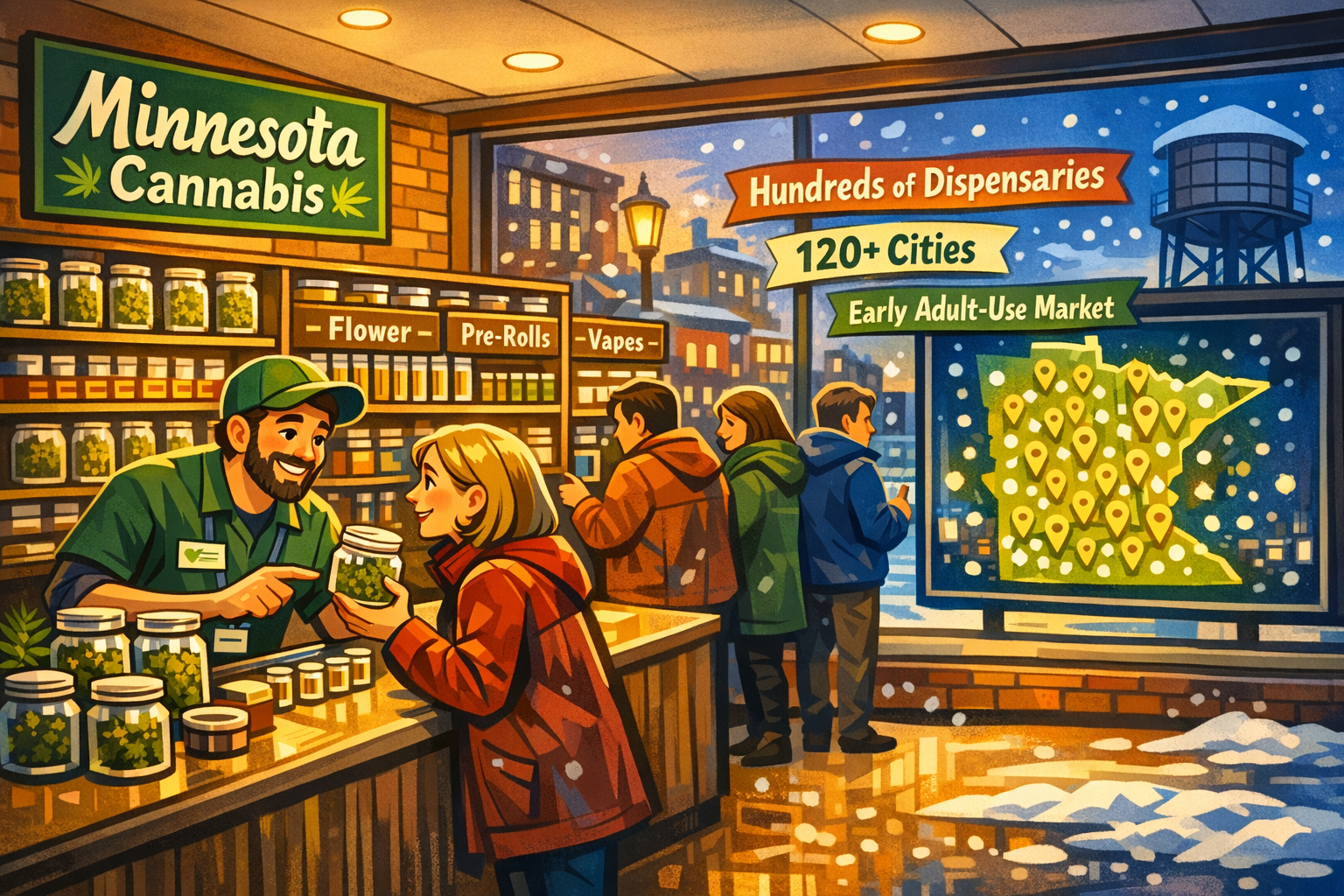
The first craft cannabis products appeared on Minnesota dispensary shelves on March 11, 2026, marking a concrete expansion of the state’s retail product mix. Craft licenses represent a new regulatory tier allowing small, independent producers to bring differentiated products to market, including vapes and specialty flower. The launch gives Minnesota’s 96 licensed dispensaries more assortment depth and creates a path for smaller cultivators to enter the state program without competing directly against large-scale operators. The Office of Cannabis Management confirmed the rollout as part of the state’s broader strategy to build a diverse supply chain that can support both established retailers and new market entrants.
For Minnesota cannabis retail, this signals the beginning of category diversification that mirrors what played out in more mature state programs like Colorado and California. Retailers now carry products from independent craft producers alongside larger license holders, which gives stores more reasons to attract customers away from illicit sources. The craft product launch also demonstrates that Minnesota’s regulatory framework is advancing beyond initial licensing into active market operations, with more product categories and license types coming online as the state program matures through 2026.
Source: MPR News — First Craft Cannabis Products Hit Dispensaries
⚖️ Rhode Island: Federal Judge Rules Dormant Commerce Clause Applies to State Cannabis Licensing
A Rhode Island federal judge ruled that the U.S. Constitution’s dormant commerce clause applies to the state’s adult-use cannabis market, placing Rhode Island’s planned 20-license lottery and related structural rules under constitutional scrutiny. The dormant commerce clause restricts state measures that burden or discriminate against interstate commerce, and the court’s ruling expands the legal challenge well beyond prior equal protection theories. The decision could force Rhode Island to eliminate or reduce cannabis retail license caps, remove geographic zoning restrictions on dispensary locations, and invalidate residency or ownership preferences favoring in-state applicants. Litigation remains ongoing, with implications for the pending 20-license lottery uncertain pending further proceedings.
This is the most consequential development in Rhode Island cannabis state programs right now. If the court ultimately finds the state’s licensing framework violates the dormant commerce clause, it could reshape how Rhode Island structures its entire cannabis retail market. Economist Beau Whitney’s analysis showing Rhode Island’s market can sustain up to 40 retail licenses without harming existing operators directly contrasts with the CCC’s current plan to award only 20 licenses. The Commission is weighing whether to slow the already delayed rollout, with the state aiming to hold the lottery in June 2026 as the key watch point for further clarity on lottery structure and award timelines.
Source: CannDev — Rhode Island Cannabis Retail March 2026
🗳️ Ohio: 400-Dispensary Cap Takes Effect March 20 After Referendum Effort Fails
Ohioans for Cannabis Choice failed to gather enough signatures by the March 19, 2026 deadline to place a referendum on the November 2026 ballot to repeal Senate Bill 56. The group needed 248,092 valid signatures from 44 counties but came up short, allowing the legislation to take effect on March 20, 2026. SB 56 imposes a 400-dispensary statewide cap, requires one-mile buffers between dispensaries and from alcohol retailers, sets a 500-foot buffer from schools and churches, caps ownership at eight dispensaries per person, and bans intoxicating hemp products outside licensed dispensaries. With the referendum effort unsuccessful, Ohio cannabis state program operators now face immediate constraints under the new law.
The implementation creates significant regulatory changes for cannabis retail across Ohio. The 400-store cap means the expansion window is narrowing with roughly 200 licenses remaining available statewide. SB 56 bans cannabis advertising across billboards, radio, TV, and internet starting March 20, elevating in-store education and budtender expertise as primary competitive levers. Recent dispensary openings across Findlay, Wellington, and New Paris confirmed operators expanded aggressively before the deadline. Cincinnati’s $2.5 million cannabis revenue allocation plan and ongoing municipal zoning debates show how Ohio’s state program continues maturing even under the new regulatory framework.
Source: Ohio Capital Journal — Referendum Effort for New Weed Law Fails
🏛️ New Jersey: State Enforcement Intensifies With License Suspensions and Product Holds
The New Jersey Cannabis Regulatory Commission suspended Jersey Strong and Mollitiam licenses on February 12, 2026 and placed all flower and product that passed through Mollitiam facilities on Administrative Hold in the state’s Metrc seed-to-sale tracking system. The action prevents transfer, distribution, or sale of those items and stems from alleged unauthorized cultivation activity at a non-sanctioned satellite site. A separate licensee received a $25,000 fine and 14-day suspension during the same meeting. The enforcement wave underscores CRC’s intensified compliance focus and multi-agency coordination with the Attorney General and State Police targeting unlicensed operators across the New Jersey cannabis state program.
The Mollitiam hold removes products from dispensary shelves, tightening short-term inventory for retailers carrying those SKUs, while the Jersey Strong suspension eliminates a competitor from active market participation. At the same time, New Jersey municipalities are recalibrating local cannabis retail frameworks: South Bound Brook voted on revised operating hours, Barrington scheduled a vote on its first retail application, and Newark added a new dispensary in the Ironbound neighborhood. The combination of stepped-up state enforcement and continued municipal expansion shows New Jersey’s cannabis state program entering a phase where compliance violations carry material business consequences while retail growth continues across urban and suburban markets.
Source: HeadyNJ — Jersey Strong, Mollitiam Cannabis Licenses Suspended by NJCRC
📊 Illinois: Cannabis State Sales Drop 12% to $1.5 Billion as Neighboring Markets Capture Share
Illinois recorded $1.5 billion in cannabis retail sales for 2025, down from $1.7 billion in 2024, a 12% decline attributed to high state taxes and consumers shopping across state lines in Michigan and Missouri. Despite lower revenue, Illinois cannabis state retailers processed a record 52.1 million adult-use transactions, signaling sustained demand but compressed per-unit pricing as flower prices fell to $5.72 per gram by November 2025. The sales decline increases pressure on retail margins and underscores the competitive threat from neighboring state programs with lower tax structures, particularly as Michigan and Missouri continue expanding their own dispensary networks and capturing Illinois consumer traffic.
The Illinois Cannabis Control Commission voted 4-0 on March 11 to extend the delivery license exclusivity period for social equity applicants from April 2026 to April 2029, preserving competitive protections for social equity operators in last-mile delivery and preventing broader market entry by non-social-equity retailers and third-party platforms. The extension reshapes omnichannel strategy for Illinois cannabis state operators, who must now structure delivery partnerships with social equity licensees or forego direct delivery entirely through 2029. Meanwhile, municipalities from Sycamore to Wood River continue approving first-time dispensaries and easing zoning barriers, showing that Illinois’ cannabis state retail network is expanding at the store level even as statewide sales contract.
Source: MJBizDaily — Illinois Cannabis Retailers Sold Record Amount of Product in 2025 But Made Less Money
💼 Cannabis Acquisition Opportunities
New York — Long Island / Brooklyn Portfolio
Ask Price: $12M for all three stores (includes inventory)
- 2 Long Island stores + 1 Brooklyn location
- Long Island stores have been open ~18 months with combined revenue of $12M+
- Brooklyn location recently opened
New York — Hudson County – Operational Dispensary
Ask Price: $2.8M (includes inventory)
- Operational for one year
- Generated $2.8M in revenue in 2025
- Projected $5.4M run rate for 2026
- Prime location on the busiest street in the municipality
- Surrounded by towns that have opted out
- Only operational dispensary permitted in the town
- 9,000 sq ft building with $20,000/month lease
New York — Cohoes, NY – Operational Dispensary
Ask Price: $2M
- 1,000 sq ft building with 11 dedicated parking spaces plus additional nearby parking
- Prime location with the highest traffic count in the area
- $2.45M revenue over the last 12 months
- 15% EBITDA
California — San Francisco (Excelsior / Mission District) – Retail Opportunity
- Mixed use property with ground floor retail and two residential units above
- Retail license secured
- Ready to build with approved PG&E contract and power upgrade scope completed
Structure Options:
- Purchase building and license: $1.5M
- Purchase license only: $75,000 + $8,000/month NNN lease
- Lease including license: $13,000/month
Interested in learning more about these cannabis acquisition opportunities? Contact us directly to get started.
The Bottom Line
March 2026 showed cannabis state programs moving in sharply different directions. Minnesota launched craft products and expanded its retail supply chain, Rhode Island’s licensing structure came under federal constitutional challenge, Ohio implemented its 400-store cap after a failed referendum challenge, New Jersey stepped up enforcement with license suspensions and product holds, and Illinois wrestled with a 12% sales decline as neighboring state markets captured consumer share. These state-level developments confirm that the national cannabis retail landscape is fragmenting along regulatory lines, with some states opening new license pathways while others face legal challenges or market contraction.
📬 Get Monthly Market Updates
Stay ahead of the curve with our monthly cannabis retail market newsletter. New markets, regulatory changes, and expansion opportunities delivered to your inbox.