
NATIONAL CANNABIS RETAIL MARKET UPDATE, JUNE 2026
June 2026 cannabis state updates are landing fast across markets that matter. Illinois just signed the most expansive retail law of the year, New York crossed $3.3 billion in cumulative adult-use sales while federal enforcement escalated upstate, and Ohio’s unified dispensary cap is reshaping who can get a license and where. Michigan’s rule rewrite is entering its final comment window, and California answered a long-standing question about tribal licensing. These five states account for a significant share of U.S. cannabis retail volume, and this month every one of them moved.
Top Headlines This Month
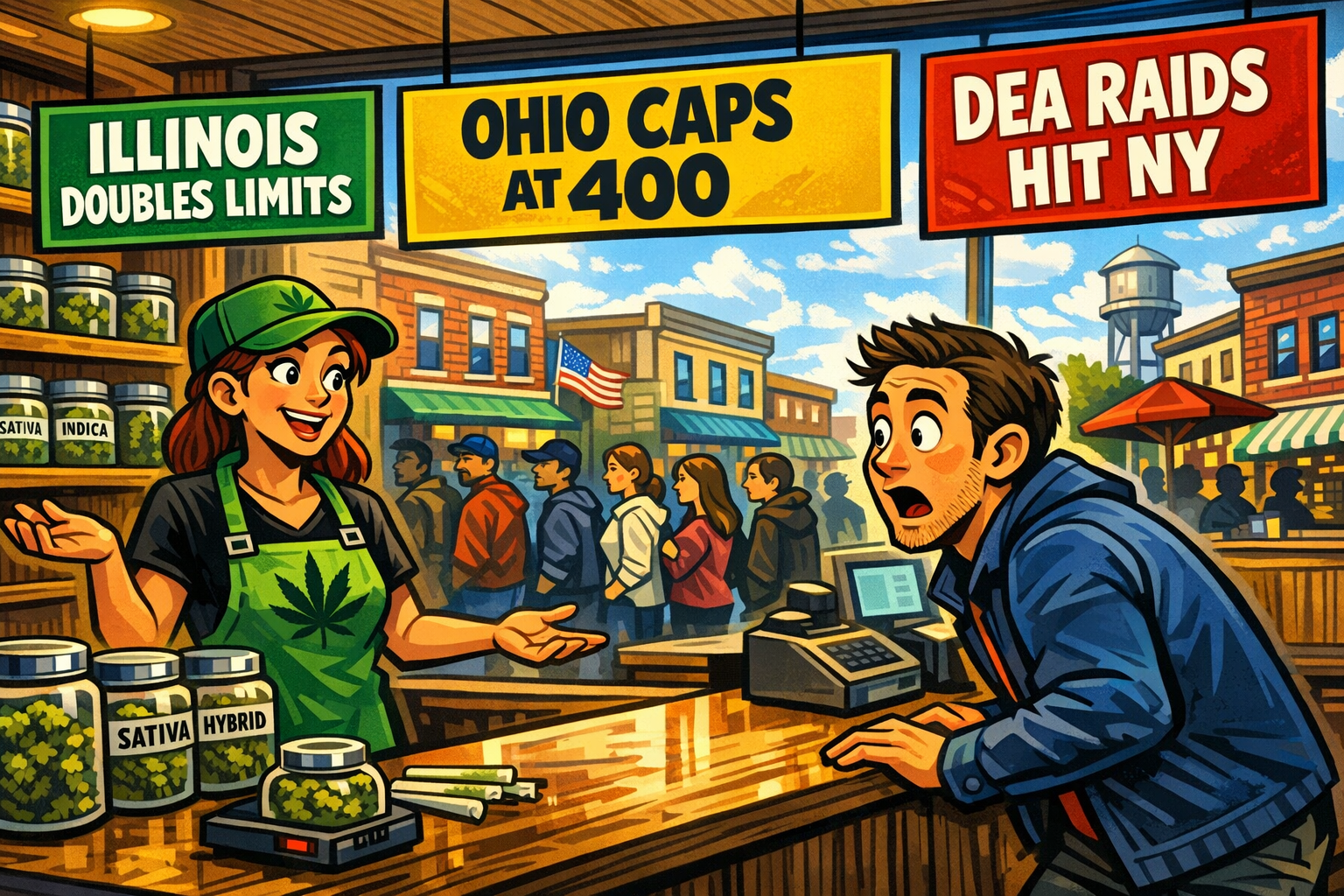
- ⚖️ Illinois SB 3222 doubles possession limits and adds dual licensing
- 📊 New York crosses $3.3B in sales as DEA targets unlicensed shops
- 🏛️ Ohio SB 56 sets 400-dispensary cap under unified Division of Cannabis Control
- 📊 Michigan April sales rebound to $258M as CRA rule rewrite nears finish
- ⚖️ California AG clarifies tribal cannabis licensing rules statewide
⚖️ ILLINOIS: SB 3222 DOUBLES POSSESSION LIMITS, ADDS DRIVE-THROUGH DISPENSING AND DUAL LICENSING
Governor JB Pritzker signed SB 3222 into law on June 12, 2026, after the Senate gave final concurrence 47 to 10 and the House passed the measure 77 to 31. The law doubles adult possession limits to 60 grams of flower, 10 grams of concentrate, and 1,000 milligrams of THC in infused products, up from the current 30 grams, 5 grams, and 500 milligrams. Nonresident limits rise to 30 grams of flower, 5 grams of concentrate, and 500 milligrams of THC. The law permits dispensaries to offer drive-through and curbside pickup for marijuana products and creates a path for existing adult-use licensees to obtain a medical dispensing organization license at the same address, beginning 90 days after the effective date, upon paying a one-time nonrefundable $5,000 fee. Both licenses are tied to the same entity and location and cannot be separated by relocation or ownership changes. Separately, Chicago’s City Council Public Safety Committee advanced an ordinance creating escalating penalties for cannabis activity near schools, parks, and playgrounds, with fines reaching $10,000 to $20,000 by a fourth offense. The Illinois Department of Revenue also notified cannabis businesses that certain municipalities and counties have imposed or changed their Cannabis Retailers’ Occupation Tax, with those changes taking effect July 1, 2026. Illinois dispensary owners are simultaneously pushing lawmakers to ease mandatory third-party security and surveillance requirements, which owners describe as costly and outdated, and to shorten required footage-retention obligations.
SB 3222 is the most consequential single piece of Illinois cannabis legislation in years. The doubled possession limits open the door to larger per-transaction purchases, the drive-through format creates a new convenience channel, and the dual licensing pathway lets adult-use businesses serve registered medical patients from a single location without a separate facility or ownership structure. The July 1 local tax adjustments and the pending Chicago penalty ordinance add compliance variables that businesses in affected jurisdictions will need to track closely.
Source:
https://themarijuanaherald.com/2026/06/illinois-lawmakers-send-sweeping-marijuana-and-hemp-bill-to-governor/
https://tax.illinois.gov/research/news/fy-2026-21.html
https://www.chicagotribune.com/2026/06/09/aldermen-penalties-marijuana-schools-parks/
📊 NEW YORK: $3.3B IN CUMULATIVE SALES AS FEDERAL ENFORCEMENT ESCALATES AND NASSAU COUNTY INCHES TOWARD RETAIL
New York’s adult-use cannabis program crossed $3.3 billion in total sales as of March 2026 and generated $429 million in state excise tax revenue. The Cannabis Control Board approved 32 new adult-use licenses at its May 7 meeting, bringing the statewide total to 2,259, with more than 655 licensed dispensaries now open. Year-to-date sales through April 2026 topped $553 million, and the 4/20 holiday week alone generated approximately $37.9 million, a 20 percent increase over the same week in 2025, with single-day sales reaching $8.6 million. Social and economic equity applicants hold 56 percent of all adult-use licenses. On the enforcement side, the DEA led a multi-agency operation in Massena on May 20 that shut three unlicensed shops and seized more than 1,000 pounds of cannabis, 40 pounds of suspected methamphetamine, and 20 illegal firearms, including an AK-47 and five AR-15s. The Office of Cannabis Management hit its 600th statewide padlocking with the closure of an unlicensed Middletown shop after a sale to a minor. In Nassau County, the Village of Lake Success applied to the Nassau County Planning Commission to create a new cannabis business zone along Northern Boulevard, a move that could bring the first adult-use dispensary to a county where nearly all municipalities opted out of cannabis by the December 31, 2021 deadline.
New York’s June 2026 cannabis state update reflects a maturing but uneven program. Cumulative sales growth and equity license distribution are moving in the right direction, but tax revenue shortfalls, enforcement capacity limits, and concentrated sales among top-performing stores show the market still has structural gaps. The DEA’s involvement in Massena marks a shift in how seriously federal agencies are treating unlicensed activity in New York, and Nassau County’s first serious push toward retail access opens a large, high-income market that has been completely locked out since legalization.
Source:
https://rochesterbeacon.com/2026/05/07/the-highs-and-lows-of-legal-cannabis/
https://cannabis.ny.gov/may2026ccbrelease
https://www.dea.gov/press-releases/2026/05/21/dea-joint-enforcement-operation-upstate-new-york-targets-unlicensed
https://libn.com/2026/06/01/lake-success-plans-cannabis-zoning-expansion/
🏛️ OHIO: SB 56 UNIFIES MEDICAL AND ADULT-USE UNDER 400-DISPENSARY CAP AS LOCAL MORATORIUMS HOLD
Ohio S.B. 56 took effect March 20, 2026, merging adult-use and medical marijuana regulations into a single Marijuana Control Law administered by a unified Division of Cannabis Control under the Department of Commerce. All dispensary licenses now combine medical and adult-use into a single credential, the statewide total is capped at 400, and DCC cannot issue a license placing a dispensary within one mile of another. The law replaces automatic approval with ranked evaluation based on eligibility, suitability, and ability to operate, and allows DCC to run a tiered lottery when applicants exceed available slots. Level III cultivator licenses are eliminated. The act appropriates $47.5 million in FY 2026 and $49 million in FY 2027 from the Host Community Cannabis Fund for excise tax distributions. At the local level, 137 Ohio jurisdictions had active moratoriums as of May 1, 2026, covering roughly 14 percent of the state’s population, with 106 of those bans carrying no defined end date. Circleville extended its moratorium 90 days to August while simultaneously hearing a market-entry pitch projecting $215,000 to $422,000 in annual tax revenue. Green Thumb Industries proposed a Rise Dispensary in Brunswick Hills with a $1.5 million to $2 million investment projection, and the Ohio Division of Cannabis Control approved Klutch Cannabis’s acquisition of a Columbus license from Farkas Farms in a simultaneous license swap.
SB 56 reshapes the competitive structure of Ohio cannabis retail at every level. The 400-dispensary cap, the one-mile spacing rule, and merit-based ranking all constrain future license volume and raise the threshold for new entrants. Existing license holders who secured permits before March 20, 2026, are protected from new local prohibition ordinances, giving them a structural advantage over applicants entering the process after the effective date. License swaps like the Klutch and Farkas Farms deal signal that Ohio’s secondary market is functioning actively under the new framework.
Source:
https://www.legislature.ohio.gov/download?key=27450
https://moritzlaw.osu.edu/faculty-and-research/drug-enforcement-and-policy-center/research-and-grants/policy-and-data-analyses/ohio-marijuana-moratoriums
https://www.mmjdaily.com/article/9844461/us-oh-klutch-cannabis-announces-acquisition-and-grand-opening-of-columbus-dispensary/
📊 MICHIGAN: APRIL SALES REBOUND TO $258M AS CRA RULE REWRITE ENTERS FINAL COMMENT WINDOW
Michigan’s adult-use cannabis market posted $258.17 million in sales during April 2026, rebounding from January’s $226.4 million, the lowest monthly figure since February 2023. A single day, April 20, generated $20.4 million, up about 27 percent from roughly $16 million on the same date in 2025, when the holiday fell on Easter Sunday. Average flower prices came in at $59.05 per ounce in April, a slight increase from $58.22 at year-end 2025. Full-year 2025 data shows retailers sold 260,000 more pounds than in 2024 but total sales fell to roughly $3.17 billion, about $113 million below 2024, because lower average prices offset the volume gain. The Cannabis Regulatory Agency’s comprehensive rule rewrite cleared the Michigan Office of Administrative Hearings and Rules on May 11, 2026, after a nearly three-year process that included a public hearing drawing 38 oral commenters and nearly 600 pages of written submissions. Because the CRA made more than 120 changes to the proposed rules after the first comment period, it announced a second public comment window and hearing before any filing with the Joint Committee on Administrative Rules. The hearing date has not yet been set. In Menominee, a 2023 settlement that let marijuana companies pay the city’s legal bills in exchange for licenses has generated an ethics complaint and warnings of possible scrutiny, with multiple parties now in active litigation, according to MLive’s reporting. New Buffalo Township scheduled revocation hearings for four dispensaries on June 22 over alleged violations including sales exceeding possession limits and surveillance system deficiencies.
Michigan’s June 2026 cannabis state update shows a market in transition on multiple fronts at once. The April sales rebound is a positive signal, but the 24% wholesale tax is still working through retail inventory chains, meaning the full consumer pricing impact has not materialized. The CRA’s second comment window is the last formal stakeholder opportunity before the rules move toward the legislature, and the licensing disputes in Menominee and New Buffalo Township show how fragile local approvals can be when procedural or compliance questions surface.
Source:
https://hempgazette.com/news/michigan-adult-use-cannabis-sales-april-2026/
https://www.cannabis-law-blog.com/final-draft-cra-rules-are-published/
https://www.michigan.gov/lara/news-releases/2026/05/14/update-on-the-marijuana-rules-promulgation
https://www.mlive.com/cannabis/2026/03/michigan-city-let-marijuana-companies-pay-its-legal-bills-now-allegations-are-flying.html
⚖️ CALIFORNIA: AG OPINION SETTLES TRIBAL CANNABIS LICENSING AND DCC RESPONDS TO FEDERAL SCHEDULE III SHIFT
California Attorney General Rob Bonta issued Opinion No. 25-102 on May 28, 2026, concluding that federally recognized Indian tribes must obtain a commercial cannabis license from the California Department of Cannabis Control to engage in commercial cannabis activity with state licensees off tribal lands. The opinion applies the Mescalero Apache Tribe v. Jones standard and requires tribes applying for a state license to also submit a written waiver of any sovereign immunity defense. Following the April 2026 federal order placing FDA-approved products and state-licensed medical marijuana in Schedule III, while leaving adult-use cannabis in Schedule I, the DCC announced a Notice of Emergency Regulatory Action on May 18 to allow licensees to hold separate adult-use and medical-use licenses simultaneously. The DCC estimates approximately 1,600 California licensees are eligible to apply. As of May 18, the department had already processed 10 designation changes to medical-only and 196 additions of medical to adult-use designations. Businesses holding separate licenses must maintain distinct books, Metrc accounts, insurance, and permits, though the DCC estimated the additional cost would be near net-zero annually. On enforcement, Attorney General Bonta filed a 66-count felony complaint in April against a defendant alleged to have operated unlicensed dispensaries across Los Angeles, Orange, and San Bernardino counties from April 2019 through November 2022, failing to report roughly $80 million in sales and nearly $7.1 million in sales taxes. Riverside opened its first licensed dispensary in March, nearly a decade after legalization, and California City voted unanimously in May to impose a 45-day moratorium on new cannabis permit approvals.
The tribal opinion removes a meaningful ambiguity in how California’s cannabis licensing framework applies to tribal entities conducting commercial activity off their own lands. The DCC’s emergency rule response to Schedule III gives roughly 1,600 licensees a path to pursue federal medical registration and potential 280E relief, though the June 29 DEA hearing on broader rescheduling could shift the regulatory picture again before many businesses complete their applications. California’s June 2026 cannabis updates reflect a state managing simultaneous federal, tribal, local, and enforcement dimensions across the nation’s largest cannabis market.
Source:
https://oag.ca.gov/system/files/opinions/pdfs/25-102.pdf
https://news.crbmonitor.com/2026/06/california-responds-to-dea-registration-rules/
https://www.westsidecurrent.com/court/unlicensed-cannabis-operator-accused-of-failing-to-report-80-million-in-sales/article_ef66d6da-05e3-42ff-abd7-378d71ed2613.html
Cannabis Business Deals
Albany, NY — Downtown Dispensary
Asking: $2,400,000
- Open and operating, 11 months in business with run rate revenue of $115K/mo and growing
- Brand new Class A 1,700 SF buildout with an 11-car lot and drive-thru infrastructure ready to activate
- No other dispensaries within half a mile, only 3 within a mile — significant market whitespace
- 46% gross margin, ~$160K net income across operating period with material EBITDA upside post-close
- Absentee owned, 14-year NNN lease at $5,300/mo — strong upside for an owner-operator
Brooklyn, NY — Manhattan Ave Corridor
Asking: $2,750,000
- Fully licensed, cash-flowing dispensary generating $2.5M to $3M annually with $25K to $35K in monthly free cash flow
- 150+ customers per day on one of Brooklyn’s fastest growing retail corridors with direct subway access
- One of NYC’s only dispensary sites with an adjoining licensed social consumption lounge opportunity
- ~3,525 SF total across ground-floor retail, 1,000 SF lounge-ready space, and finished basement
- Full financials and lease available under executed NDA
Rosedale, Queens, NY
Asking: $900,000
- Established dispensary consistently grossing $100K to $110K+ per month
- 47-48% gross margin, $8,000/mo rent — strong cash-on-cash returns
- Active offers in hand, just began broader marketing
- Majority-cash offers preferred
Staten Island, NY — Port Richmond
Asking: $950,000
- Pre-opening dispensary delivered turnkey and ready to operate at closing
- Seller owns the real estate and is open to leasing or selling the property
- ~1,200 to 1,300 SF ground floor plus full basement, street parking and a lot directly across the street
- Lease at $8,000 to $9,000/mo, 6 to 8 weeks from opening
Camden, NJ — Licensed Dispensary
Asking: $400,000
- Fully licensed dispensary generating $1.5M in 2025 revenue
- 2,500 SF space at $5,625/mo with lease transfer included in the purchase
- Purchase includes the license and full lease assignment — turnkey acquisition
- One of the most competitively priced cash-flowing dispensaries currently on the market
The Bottom Line
June 2026 cannabis state updates delivered consequential shifts across five of the country’s most closely watched marijuana retail markets. Illinois rewrote its retail rulebook with SB 3222, New York’s enforcement and licensing numbers both climbed, Ohio locked in its unified 400-cap framework under SB 56, Michigan balanced a sales rebound against regulatory and licensing friction, and California answered the tribal licensing question while responding to the federal Schedule III shift. These are the states shaping what national cannabis retail looks like heading into the second half of 2026.
📬 Get Monthly Market Updates
Stay ahead of the curve with our monthly cannabis retail market newsletter. New markets, regulatory changes, and expansion opportunities delivered to your inbox.