
CA Monthly Puff: Humboldt Settles, SLO Cuts Tax, Sutter Creek Approves Retail
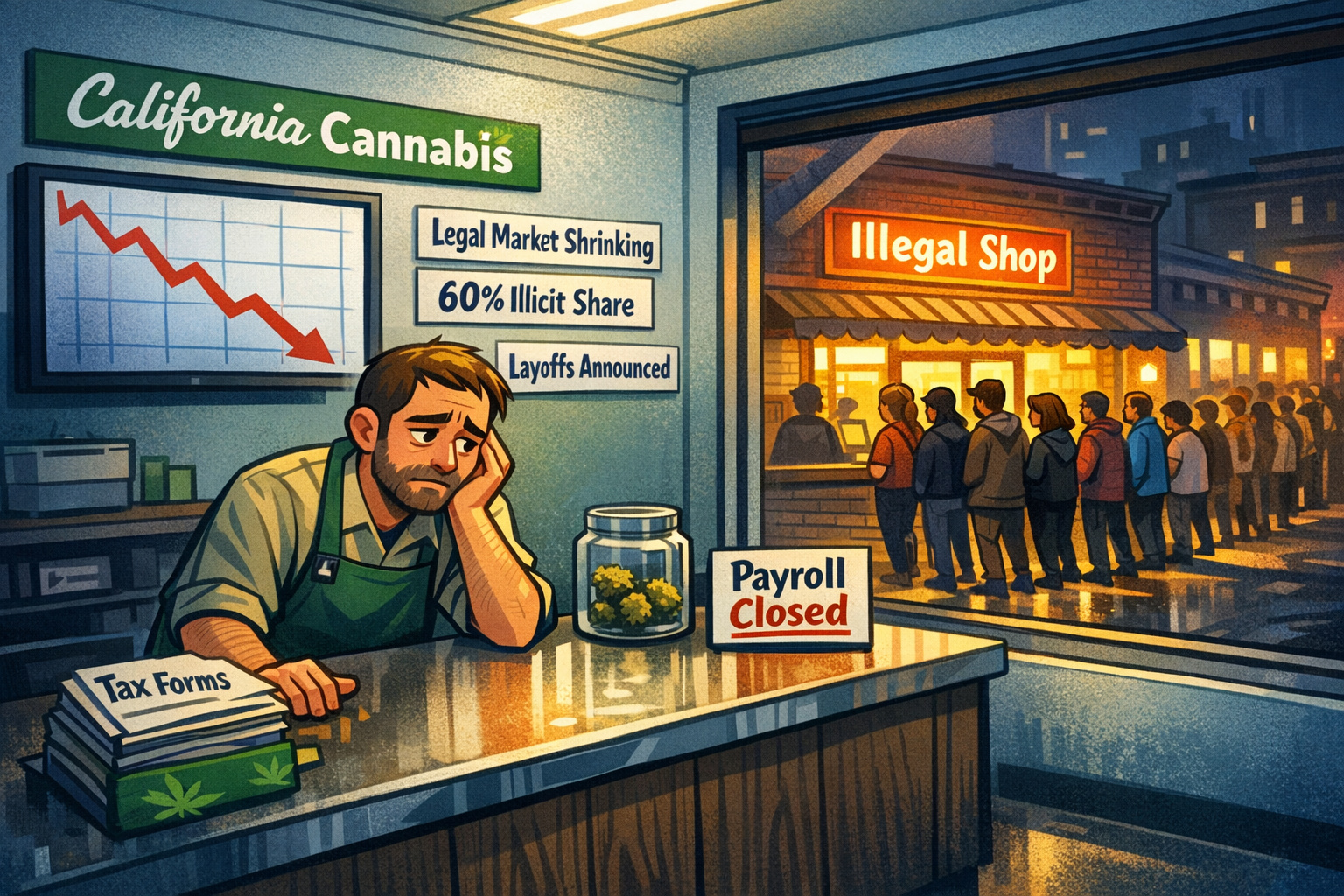
California cannabis retail August 2026 was defined by legal pressure, local tax cuts, and a shrinking licensed market. Humboldt County settled a federal abatement lawsuit that rewrites its enforcement playbook, San Luis Obispo County trimmed its cannabis business tax to 6%, and Sutter Creek approved its first licensed dispensary. Meanwhile, statewide taxable sales continued to contract in Q1 2026 as the illicit market held 60% share.
Top Headlines This Month
- Sutter Creek: City Council Approves Embarc Dispensary Agreement and Zoning Amendment
- Humboldt County: Federal Cannabis Abatement Settlement Overhauls Enforcement Procedures
- San Luis Obispo County: Cannabis Business Tax Rate Cut to 6% Starting October 1
- California: Licensed Cannabis Sales Contract as Illicit Market Holds 60% Share
Sutter Creek: City Council Approves Embarc Dispensary Agreement and Zoning Amendment
The Sutter Creek City Council voted at its August 17, 2026 meeting to approve a package of actions bringing the city its first licensed retail cannabis dispensary. The applicant is Sutter Creek Responsible and Compliant Retail LLC, operating under the name Embarc, proposing a retail and delivery cannabis business at 11 Ridge Road. In a split vote, the council approved a development agreement with Embarc and adopted two ordinance amendments to the Sutter Creek Municipal Code: one authorizing commercial cannabis as a conditional use when approved by a conditional use permit, and another specifically authorizing a single retail storefront cannabis dispensary as a conditional use in any zoning district, subject to execution of a development agreement. The council also considered an appeal of the Planning Commission’s earlier approval of the site plan permit, conditional use permit, and sign permit for the same project. City staff had recommended approval of all proposed actions, with the project deemed categorically exempt under CEQA. Sutter Creek is a small city, and the zoning amendments open any district in the city to a single dispensary under a conditional use permit framework, which is a notable structural change. With council approval secured, Amador County will get its first licensed marijuana dispensary, filling the former Umpqua Bank location on Ridge Road.
Humboldt County: Federal Cannabis Abatement Settlement Overhauls Enforcement Procedures
Humboldt County has agreed to a settlement in Thomas et al. v. County of Humboldt, a federal lawsuit filed by the Institute for Justice on behalf of five property owners who challenged the county’s cannabis abatement program, known as HEIR. The fully executed settlement, signed August 19, requires the county to withdraw all active cannabis-related notices and proposed fines against the five plaintiffs and pay $350,000 toward their expenses and attorneys’ fees. Beyond the financial terms, the agreement forces a structural overhaul of the county’s enforcement process. The county must now send a warning letter before issuing any notice of violation, give property owners 30 days to respond with acceptable proof such as dated photographs or a voluntary inspection, and may no longer rely solely on satellite imagery if the owner provides that proof. Future Category 4 notices, which carry penalties of up to $10,000 per violation per day, must specifically describe the alleged violation rather than just cite code sections. Appeal hearings must be scheduled within 60 days of an appeal request and held within 60 days after that. Category 4 fines will not begin accruing until 10 days after final adjudication, so owners who appeal on time will not accumulate penalties while waiting for a hearing. New property owners are also protected from fines tied to a prior owner’s cannabis activity unless cultivation continues for more than 30 days after the new owner takes title. The county does not admit wrongdoing. A federal court will retain jurisdiction to enforce the settlement for three years after dismissal. This settlement closes a chapter that began with property owners facing proposed penalties in the millions of dollars and multi-year waits for hearings, with no fines paused during that time. The procedural changes apply going forward to all Humboldt County cannabis abatement enforcement, not just to the five plaintiffs, so the practical reach of the agreement extends well beyond the individual case.
San Luis Obispo County: Cannabis Business Tax Rate Cut to 6% Starting October 1
The San Luis Obispo County Board of Supervisors adopted an ordinance on August 4, 2026 reducing the Cannabis Business Tax rate from 8% to 6% for cannabis businesses operating in the unincorporated areas of the county. The reduced rate takes effect October 1, 2026. Cannabis businesses must continue collecting and remitting the tax at the 8% rate for all transactions through September 30, 2026, including those in July, August, and September. The 6% rate applies only to transactions occurring on or after October 1. This reduction lowers the local tax burden on licensed cannabis businesses in the county’s unincorporated areas. The two-point cut is modest, and for retailers already operating on thin margins in a contracting licensed market, the change takes effect with the October reporting period.
California: Licensed Cannabis Sales Contract as Illicit Market Holds 60% Share
California’s licensed cannabis market continues to shrink. Taxable cannabis sales peaked at roughly $5.8 billion in 2021 and have declined in each subsequent year, according to the state Department of Tax and Fee Administration. The Department of Cannabis Control estimates that legal sales represent only 40% of total marijuana consumption in California, with illicit operators controlling the remaining 60%. Those pressures hit close to home in the North Bay last month, when Santa Rosa-based businesses CraftForce Services Inc., the manufacturing arm of CannaCraft, and Queen City Staffing announced layoffs of approximately 60 employees in production, packing, and trimming. Groundwork Holding Inc. CEO Bret Peace attributed the cuts to economic downturn and competition from the illicit market. Sonoma County currently has 66 licensed cannabis businesses, including 31 distributors, 23 manufacturers, and 12 microbusinesses. Local retailers describe a squeeze from multiple directions: rising electricity rates, a minimum wage in Santa Rosa that has risen to $18.21, market oversaturation, and limited banking access tied to federal prohibition. State Treasurer Fiona Ma convened a panel on July 29 bringing together government officials, financial institutions, and labor and business representatives to discuss banking challenges facing the legal market. On the tax side, Governor Newsom signed a bill in 2025 temporarily rolling the state cannabis excise tax back from 19% to 15% through 2028, and Sonoma County’s Board of Supervisors voted in April to zero out its cultivation and manufacturing tax for one year. The gap between the legal and illicit markets in California is not narrowing. Even with recent tax relief at both the state and local level, licensed retailers and manufacturers in the North Bay are reporting revenue declines, workforce reductions, and shrinking pools of nearby businesses to work with. Banking access and federal criminalization remain unresolved structural barriers that compound every other cost pressure in the licensed market.
The Bottom Line
California cannabis retail in August 2026 showed local governments easing pressure through tax cuts and enforcement reform while the licensed market kept contracting. Humboldt’s settlement reshapes abatement enforcement county-wide in practice, SLO’s rate drop takes effect October 1, and Sutter Creek approved zoning changes that open any district to a single dispensary. The structural gap between legal and illicit sales remains the defining issue for the state’s cannabis market.
📬 Get Monthly Market Updates
Stay ahead of the curve with our monthly cannabis retail market newsletter. New markets, regulatory changes, and expansion opportunities delivered to your inbox.