NATIONAL CANNABIS RETAIL MARKET UPDATE, JULY 2026
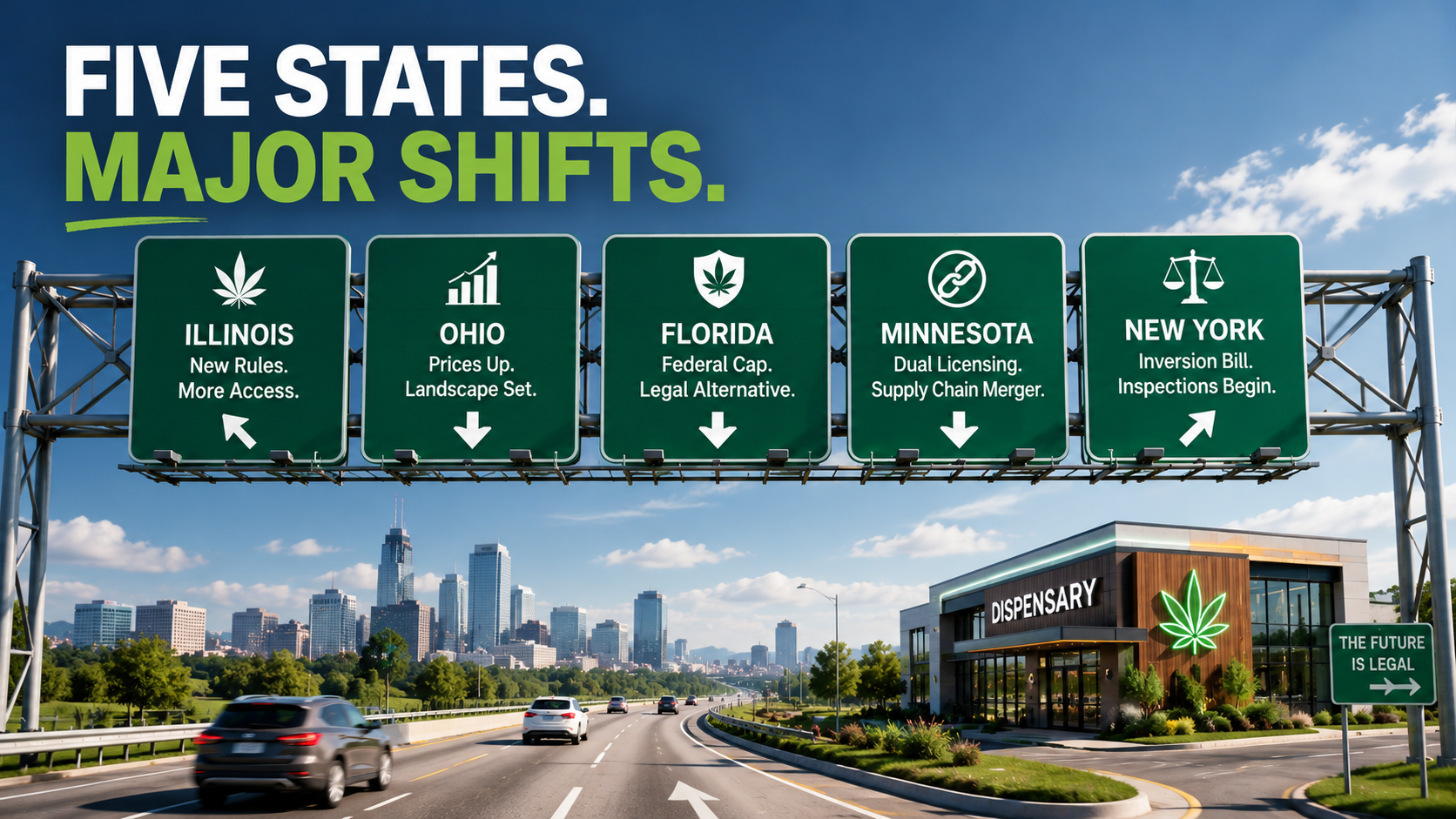
July 2026 cannabis state updates landed with real structural weight across the country. Illinois signed the biggest amendment to its Cannabis Regulation and Tax Act since legalization, reclassifying intoxicating hemp, doubling possession limits, and adding drive-throughs, 2 a.m. hours, and a medical tax exemption in one stroke. Ohio continues to carry the highest eighth-of-flower price of any tracked U.S. market while local zoning decisions permanently reshape where dispensaries can open. Florida’s state-licensed dispensaries are positioned to become the primary legal alternative for intoxicating cannabinoid consumers ahead of the November 12 federal hemp cap, though only for those willing to enroll in the state’s medical program. Minnesota locked in a two-phase restructuring with dual licensing arriving August 1 and a full supply chain merger following January 1, 2027. New York‘s legislature sent a cannabis inversion bill to the governor’s desk while OCM won three court rulings and the DEA began on-site visits at state-licensed stores. Five states, five different pressure points, all moving at the same time.
Top Headlines This Month
- 🏛️ Illinois SB 3222 rewrites dispensary and hemp rules with drive-throughs, higher possession limits, and a medical tax exemption
- 📊 Ohio tops national eighth pricing at $31.11 as zoning decisions lock in retail geography
- 🏛️ Florida federal hemp cap positions licensed dispensaries as the primary legal alternative after November 12
- 🏛️ Minnesota dual licensing lands August 1, supply chain merger follows January 2027
- ⚖️ New York cannabis inversion bill passes legislature, DEA begins on-site inspections
🏛️ ILLINOIS: SB 3222 OVERHAULS CANNABIS AND HEMP RULES IN JULY 2026 STATE UPDATES
Governor J.B. Pritzker signed Senate Bill 3222 on June 12, 2026, making the most consequential amendment to Illinois’ Cannabis Regulation and Tax Act since its 2019 enactment. The 644-page bill is, at its core, intoxicating hemp legislation. It reclassifies intoxicating hemp products such as delta-8, THC-P, and HHC under the Cannabis Regulation and Tax Act effective November 12, 2026, moving them out of unregulated gas station and smoke shop channels and into the licensed system. The bill also doubles adult possession limits to 60 grams of flower, 10 grams of concentrate, and 1,000 milligrams of THC in infused products.
On the retail side, the bill authorizes dispensary drive-through service, with pickup expanded to sidewalks and parking lots contiguous to dispensary property, and extends operating hours from the prior 6 a.m. to 10 p.m. cap to 6 a.m. to 2 a.m. subject to local zoning. Security requirements shift from mandatory contracts with licensed security firms to maintaining on-site guards. The bill creates a new Medical Cannabis Dispensing Organization License, available to existing adult-use dispensary holders 90 days after signing, meaning applications open around September 10, 2026. That license exempts purchases by qualified patients, provisional patients, caregivers, and Opioid Alternative Pilot Program participants from the Cannabis Purchaser Excise Tax. Patients may now obtain medical cannabis from any dispensary holding that license statewide, ending the prior single-designated-dispensary requirement. Craft grower canopy expands from 5,000 to 14,000 square feet, a new standalone processor organization license covers extraction and manufacturing, and civil penalties for unlicensed cannabis sales reach $10,000 per violation, with each day constituting a separate offense.
Alongside the legislation, a Cook County Circuit Court blocked the Bloc Dispensary at 400 S. Wells St. in the Loop under Illinois’ 1,500-foot dispensary separation rule. Judge Patrick Stanton held that the closer-spacing exception does not apply when both operators hold social equity licenses, setting what appears to be the first judicial interpretation of that question. Ivy Hall co-founder David Berger was sentenced on July 1 to one year in federal prison for money laundering and structuring tied to chartering private jets for a cocaine trafficker, conduct unrelated to his cannabis operations. His state cannabis license was terminated on May 11, 2026. A single Terrabis recreational dispensary in Grayville has generated more than $1.2 million in local cannabis sales tax revenue since June 2023 under the city’s 3% local rate.
The medical tax exemption in SB 3222 is the most direct financial change for dispensaries that pursue the new license. Adult-use excise tax rates remain at 10% for products at 35% THC or below, 25% for higher-THC products, and 20% for infused products, so qualified patients purchasing through a medical dispensing organization may see significant savings on higher-taxed items. The medical license must remain co-located with the corresponding adult-use license and cannot be transferred independently. Operators should also be watching the November 12 hemp reclassification date, which aligns Illinois with the federal hemp cap taking effect the same day.
Source:
https://www.foxrothschild.com/publications/illinois-overhauls-its-cannabis-and-hemp-regulations
📊 OHIO: HIGHEST EIGHTH PRICE IN THE COUNTRY AS JULY 2026 STATE CANNABIS UPDATES RESHAPE LOCAL ZONING
Ohio carried the highest average eighth-of-flower price among all 12 states tracked by Headset in June 2026, at $31.11, compared to a 12-market average of $20.64. The 2.7x spread between Ohio and Oregon’s $11.55 reflects Ohio’s status as a newer limited-license market against one of the most mature and oversupplied markets in the country. Nationally, the average cannabis product sold for $15.91 in June 2026, down 3.3% from June 2025, with average discount rates rising from 22.8% to 26.0% across tracked markets.
King City Gardens, a Cincinnati-based veteran-owned cultivator and processor, announced an exclusive partnership to manufacture and distribute Jeeter products throughout Ohio beginning in July. Jeeter topped all pre-roll brands nationally in 2025 with $253.2 million in revenue on 10.875 million units sold, more than double the second-place brand. Production stays in-state, and statewide distribution through King City Gardens’ licensed network follows an exclusive launch weekend at The Garden dispensary locations in Cincinnati.
On the zoning front, Shaker Heights advanced a text amendment that would allow dispensaries as a conditional use in commercial districts, with a 500-foot buffer from sensitive uses, a one-mile spacing requirement between dispensaries, and operating hours capped at 7 a.m. to 9 p.m. City Council held a second reading on July 27, with a third reading and public hearing scheduled for August 10. In Circleville, years of city council inaction allowed Pure Ohio Wellness to secure a site in neighboring Circleville Township instead, and the Ohio Division of Cannabis Control’s mandatory one-mile buffer around the approved township site now legally blocks the U.S. Route 23 corridor within city limits from hosting any dispensary. The company had projected between $215,000 and $422,000 annually in local tax revenue and roughly 25 jobs for a city location.
Ohio’s price premium signals a still-maturing limited-license market, but the accelerating national discount trend and far lower prices in neighboring mature markets indicate that compression is building. The Circleville outcome makes the stakes concrete: the first jurisdiction to approve a dispensary site forecloses the market for neighboring municipalities within a one-mile radius under Ohio’s DCC spacing rules.
Source:
https://www.headset.io/data/cannabis-prices
🏛️ FLORIDA: FEDERAL HEMP CAP POSITIONS LICENSED DISPENSARIES AS PRIMARY LEGAL ALTERNATIVE IN JULY 2026 CANNABIS STATE UPDATE
A new federal definition of hemp takes effect November 12, 2026, capping finished consumer products at 0.4 mg of combined total THC and THC-like cannabinoids per container. The change, included in Section 781 of a 2026 federal spending law, redefines hemp by measuring total THC rather than delta-9 only, effectively closing the loophole that allowed a wide range of intoxicating hemp-derived products to be sold at gas stations, smoke shops, and beverage retailers across Florida. The U.S. Hemp Roundtable estimates roughly 95% of today’s hemp-derived cannabinoid products become federally unlawful when the rule takes effect. Economist Beau Whitney of Whitney Economics has put Florida’s licensed hemp retail channel at roughly $6.9 billion in annual sales across about 9,500 retailers, an estimate dating to roughly 2023 and produced with funding from hemp industry groups. Other estimates of the Florida market run considerably lower, in the range of several hundred million dollars to more than $1 billion annually, so the true size of the displaced channel is genuinely uncertain.
Florida’s MMTC framework is not affected by the federal change. Consumers who previously purchased intoxicating hemp products outside the medical program will have no legal retail channel for comparable products after November 12 unless they qualify for and obtain a Florida medical marijuana card. That card requirement is the key constraint: licensed dispensaries are the primary legal alternative, not an open one.
Florida’s Office of Medical Marijuana Use reported 932,670 active qualified patients as of mid-June 2026, with 10.3 billion milligrams of THC dispensed year-to-date and 767 approved dispensing locations. Trulieve led the market by volume, dispensing from 169 locations during the June 12 to 18 reporting week. FINO Cannabis was newly approved as a Florida dispensing location in Clermont in June 2026. The Inverness City Council gave final approval on July 7, by a 4-1 vote, to an ordinance banning additional medical marijuana dispensaries from opening within city limits, following a 4-1 first reading on June 16.
The November 12 federal hemp deadline represents a meaningful structural shift for Florida’s state-licensed dispensary market, but the size of the resulting patient migration is an open question. A large pool of consumers loses its current supply, yet converting those consumers requires a qualifying condition, a physician certification, and state registration. Patient enrollment growth and dispensary traffic volumes in the months following November 12 will indicate how much of that demand actually clears those hurdles and moves into the regulated channel.
Source:
https://greenscreens.tv/v2/blog/florida-hemp-thc-ban-nov-2026-dispensary-merchandising/
Source:
https://themarijuanaherald.com/2026/06/florida-10-3-billion-thc/
🏛️ MINNESOTA: DUAL LICENSING LANDS AUGUST 1 AS SUPPLY CHAIN MERGER FOLLOWS IN JANUARY 2027
Governor Tim Walz signed Minnesota’s 2026 omnibus cannabis bill on May 26, with most provisions taking effect August 1, 2026. The most immediate change is dual licensure: the prohibition on a single owner holding both a cannabis business license and a hemp business license is removed, so hemp businesses can pursue cannabis licenses without divesting hemp operations. The change arrives ahead of the federal hemp redefinition taking effect November 12, 2026, giving hemp businesses roughly three months to pursue cannabis licensure before the federal cap reshapes what they can legally sell.
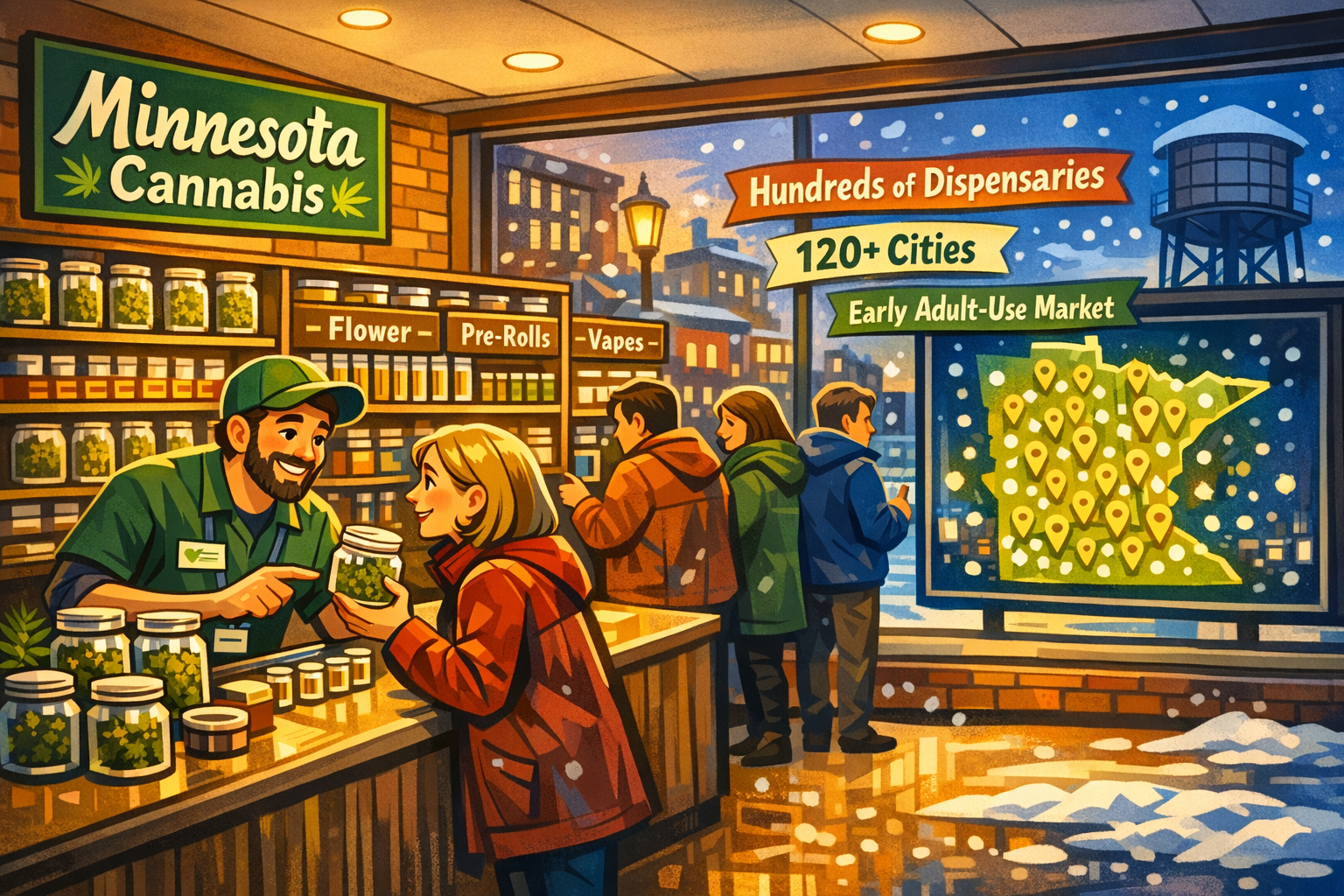
Minnesota’s Office of Cannabis Management reported 281 licenses issued from 3,541 total applicants as of July 13, with 1,308 applications in preliminarily approved status, 387 denied, and 510 listed as qualified and working through background checks and labor peace agreements. These figures update weekly. The OCM annual petition window for new product categories and delivery methods opened July 1 and closes at 4 p.m. on July 31, with decisions expected by the end of the year.
The larger structural changes arrive January 1, 2027: Minnesota’s bifurcated supply chain ends, with the adult-use and medical cannabis distinction moving to the point of retail sale for the majority of the supply chain. The same date introduces new medical endorsements, a patient product fulfillment requirement for endorsed retailers, and the macrobusiness license, which caps indoor canopy at 38,000 square feet and allows up to eight retail locations per license. A statewide cap of eight macrobusiness licenses applies through January 1, 2030, and current medical cannabis combination business license holders are required to convert to macrobusiness licenses.
Minnesota’s two-phase restructuring is the most architecturally significant change to the state’s cannabis program since launch. The macrobusiness canopy ceiling of 38,000 square feet represents a meaningful reduction from the 90,000 square feet currently available to medical cannabis combination businesses, with limited incremental canopy restoration available through successive renewals for businesses in good standing. The statewide cap of eight macrobusiness licenses through 2030 concentrates scale at the top tier of the market for several years.
Source:
https://mn.gov/ocm/data-reports/application-data/
⚖️ NEW YORK: CANNABIS INVERSION BILL CLEARS LEGISLATURE AS DEA INSPECTIONS BEGIN AT LICENSED STORES
The New York State Legislature passed S8951B/A10698B in June 2026, a bill that would make New York the first state in the country to formally define cannabis inversion in statute and build a comprehensive enforcement structure around it. The bill has not yet been signed. It awaits Governor Hochul’s approval and would take effect only upon signature, so inversion is not currently prohibited under the proposed framework.
Cannabis inversion refers to the introduction of illicit cannabis into the regulated marketplace through fraudulent or deceptive means. The bill, introduced by Senator Jeremy Cooney and advanced in the Assembly by Assemblymember Landon Dais, includes a direct statutory prohibition on inversion, expanded regulatory authority to investigate inversion schemes, prohibitions on fraudulent testing results and manipulated inventory records, and authority to suspend licenses and seize illicit products. Penalties would reach up to $10,000 per day, with multipliers and possible product seizure.
Separately, the Office of Cannabis Management announced in June that it had prevailed in three court rulings affirming its licensing and enforcement authority. Per OCM, courts upheld its denial of a microbusiness license based on evidence of unlicensed cannabis activity, dismissed challenges to Notices of Violation filed before administrative review was complete, and upheld its prohibition on issuing multiple licenses for the same address. New York’s Third Appellate Department also reversed a lower court injunction in Matter of Super Smoke N Save LLC v. New York State Cannabis Control Board, restoring warrantless inspection authority over cannabis and hemp retailers and finding that licensure itself constitutes advance consent to regulatory inspections. On a separate track, the DEA has begun conducting on-site inspections at state-licensed cannabis businesses that applied to register under the federal rescheduling initiative, with one dispensary reporting a six-hour visit and describing agents as cordial and candid about being new to the process.
The inversion bill, if signed, would give New York regulators a statutory framework specifically designed to identify and penalize illicit cannabis moving through the legal supply chain, something no other state currently has. Operators should track the bill’s status through the governor’s desk rather than treating it as settled law. In the meantime, the three OCM court wins, the restored inspection authority, and active DEA visits on the ground already add up to a significantly heavier enforcement environment across New York’s cannabis market heading into the second half of 2026.
National Acquisition Opportunities
Brooklyn, NY — Park Slope (4th Ave)
Asking: $3,000,000
- Open just over 12 months, generating $2.6M in gross revenue with increasing month-over-month sales
- $850K in net profit over the last 12 months
- 2,000 SF space on a 10+ year lease at $25,750/mo with 25,000 daily traffic count
- Strong unit economics with revenue and profitability trajectory heading in the right direction
Albany, NY — Downtown
Asking: $2,400,000
- Open and operating, 11 months in business with run rate revenue of $115K/mo and growing
- Brand new Class A 1,700 SF buildout with an 11-car lot and drive-thru infrastructure ready to activate
- No other dispensaries within half a mile, only 3 within a mile with significant market whitespace
- 46% gross margin, ~$160K net income across operating period with material EBITDA upside post-close
- Absentee owned, 14-year NNN lease at $5,300/mo with strong upside for an owner-operator
Florida — Vertical MMTC Platform (Statewide)
Asking: Contact for pricing
- Vertical Florida MMTC license with unlimited cultivation capacity and unlimited dispensary openings statewide, all state authorizations already received
- Turnkey light-deprivation greenhouse: 20,000 SF of operating cultivation on 70+ acres of zoned Ag land with significant expansion runway and no building permits required
- Four operating retail dispensaries across four distinct regional markets, available via lease transfer for an immediate statewide footprint from day one
- Asset-light structure with approximately $950K in aggregate annual rent across all five leases, with retail terms running through 2032 to 2038
- Florida on pace to surpass $2B in statewide medical sales in 2026, with only 40 MMTC licenses issued in a state of 23M+ residents — one of the most defensible license positions in the US
- NDA required for full CIM, asset addresses, lease abstracts, and data room access
Staten Island, NY — Port Richmond
Asking: $850,000
- Pre-opening dispensary delivered turnkey and ready to operate at closing
- Seller owns the real estate and is open to leasing or selling the property
- 1,200 to 1,300 SF ground floor plus full basement, street parking and a lot directly across the street
- Lease at $8,000 to $9,000/mo, 6 to 8 weeks from opening
Camden, NJ — Licensed Dispensary
Asking: $400,000
- Fully licensed dispensary generating $1.5M in 2025 revenue
- 2,500 SF space at $5,625/mo with lease transfer included in the purchase
- Purchase includes the license and full lease assignment, turnkey acquisition
- One of the most competitively priced cash-flowing dispensaries currently on the market
Plus, CannDev has access to multiple paper licenses for all types in Minnesota, and New York.
The Bottom Line
July 2026 cannabis state updates delivered structural change across five of the country’s most consequential markets. Illinois rewrote both its retail operating rules and its hemp framework in the most sweeping legislative amendment since legalization. Ohio confirmed its place at the top of national eighth pricing while local zoning decisions began locking in permanent retail geography. Florida’s licensed dispensaries are positioned to absorb whatever share of intoxicating cannabinoid demand can clear the medical card requirement after the November 12 federal hemp cap takes effect. Minnesota moved into a two-phase restructuring that redraws the top tier of its market through 2030. New York’s legislature sent inversion enforcement to the governor’s desk and OCM gained three court wins, all as the DEA began showing up in person at state-licensed stores across the country.
📬 Get Monthly Market Updates
Stay ahead of the curve with our monthly cannabis retail market newsletter. New markets, regulatory changes, and expansion opportunities delivered to your inbox.