
NY Monthly Puff: Inversion Bill Passes, DEA Inspections Begin, Courts Back OCM
June brought a wave of activity shaping New York cannabis inversion enforcement, federal oversight, and local zoning fights. The legislature sent a first-in-the-nation inversion bill to Governor Hochul, the DEA started on-site visits at state-licensed cannabis businesses under rescheduling, and three court rulings shored up OCM’s discretion over licensing and violations. On Long Island, Lake Success moved to expand its cannabis zone in a county that has almost no recreational retail.
Top Headlines This Month
- 🏛️ DEA starts on-site inspections at state-licensed cannabis shops
- 🏙️ Lake Success proposes new cannabis zone on Northern Boulevard
- ⚠️ Appeals court restores warrantless inspections of hemp retailers
- 🏛️ Three June rulings back OCM licensing and enforcement authority
- ⚖️ Legislature passes cannabis inversion bill
🏛️ FEDERAL: DEA BEGINS ON-SITE INSPECTIONS AT STATE-LICENSED CANNABIS BUSINESSES UNDER RESCHEDULING
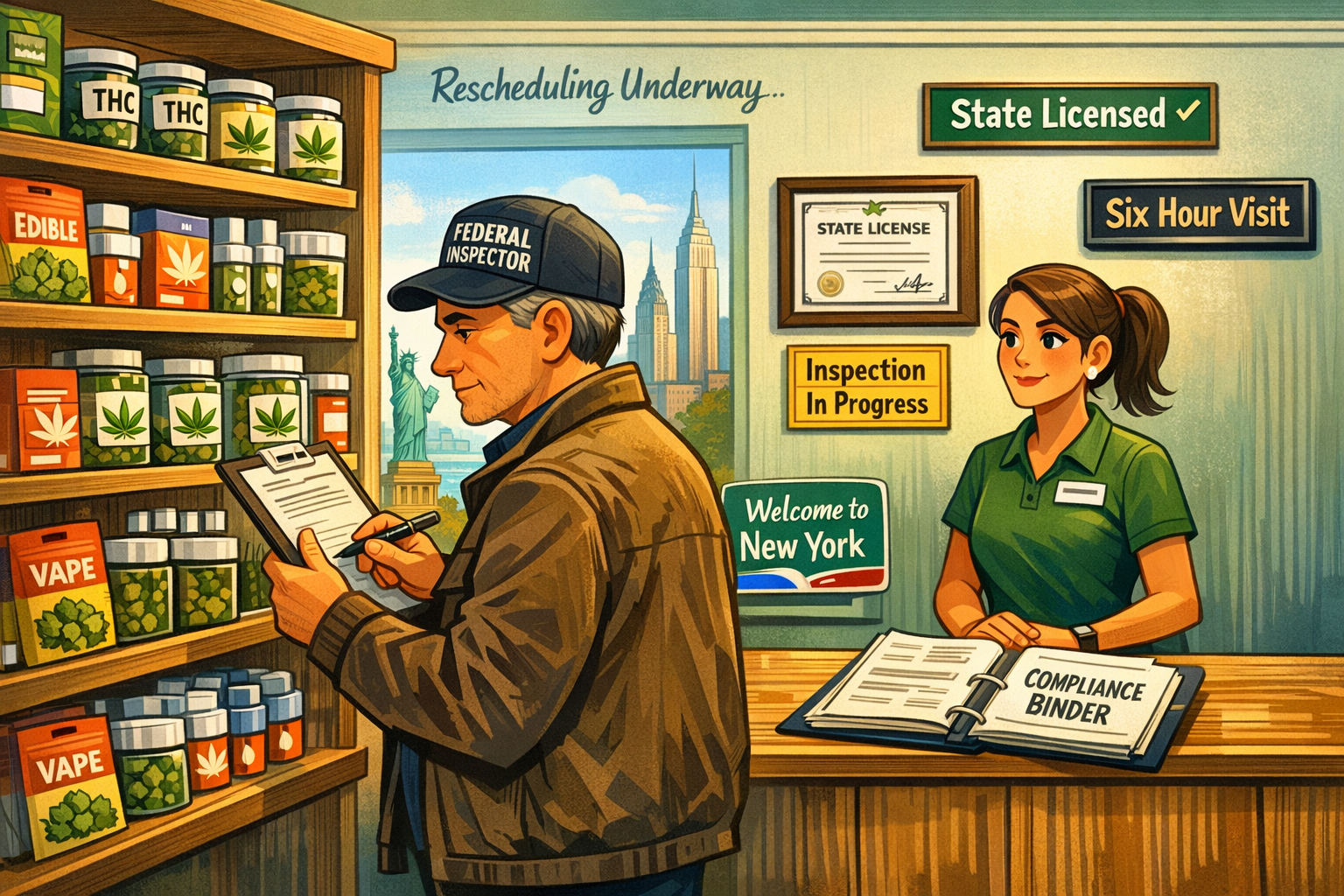
The Drug Enforcement Administration has begun conducting on-site inspections at state-licensed cannabis businesses that applied to register for federal protections under the Trump administration’s rescheduling initiative. One dispensary reported a six-hour DEA visit and described the agents as very cordial and new to the process, with an attitude of working through it together. Separately, the U.S. Supreme Court issued a unanimous ruling that a marijuana consumer’s prosecution for possessing a firearm violated the Second Amendment, with the court noting that the government’s broad ban is at odds with the administration’s own move to federally reschedule cannabis. The DEA also announced the participants for its rescheduling hearing, selecting only opponents of reform. A Marijuana Policy Project analysis released around the same time found that states have generated more than $28 billion in recreational cannabis tax revenue since legal markets first came online. The DEA inspections mark a tangible step in the federal process for cannabis businesses that registered under rescheduling, and the tone of the initial visits suggests the agency is still building out its process. The Supreme Court ruling adds another layer of legal tension around federal cannabis policy at a moment when the rescheduling process itself remains contested.
🏙️ LAKE SUCCESS: NASSAU COUNTY VILLAGE PROPOSES CANNABIS ZONING EXPANSION TO ENABLE FIRST RETAIL DISPENSARY
The Village of Lake Success applied to the Nassau County Planning Commission to add a new cannabis business zone on its northern border, covering commercial parcels on Northern Boulevard between 554 and 566, including a gas station and convenience store, an office building, and a retail building. Mayor Adam Hoffman confirmed the move is revenue driven, pointing to the village’s entitlement to a share of sales tax and store revenue from any dispensary that opens. The village already has an existing cannabis zone covering roughly a dozen office properties near the Northern State Parkway, but those properties have not leased to cannabis businesses, in part because properties with mortgages from federally chartered lenders are prohibited from doing so while cannabis remains federally illegal. Nassau County has no recreational retail dispensaries, as nearly all of the county’s municipalities with commercial properties opted out by the state’s December 31, 2021 deadline. The proposed parcels meet state OCM location requirements, satisfying the required buffer distances from schools and houses of worship. The proposal was listed on the Nassau County Planning Commission’s June 4 agenda and requires a public hearing and village board vote before taking effect. Nassau County’s absence from New York’s recreational cannabis market reflects how the opt-out decisions made in late 2021 continue to shape where dispensaries can open across Long Island. Lake Success is now trying to create a workable zone after property owners in its existing cannabis area declined to lease to cannabis businesses, in part due to federal mortgage restrictions, and the revenue figures the mayor laid out reflect the financial case driving the proposed expansion.
Source:
https://libn.com/2026/06/01/lake-success-plans-cannabis-zoning-expansion/
⚠️ NEW YORK: APPEALS COURT RESTORES WARRANTLESS INSPECTION AUTHORITY OVER CANNABIS AND HEMP RETAILERS
New York’s Third Appellate Department reversed a lower court injunction that had barred the state’s cannabis agency and the New York City Sheriff’s Office from conducting warrantless searches and seizures of licensed hemp stores. Five New York hemp retailers had filed suit after their products were seized, arguing the searches violated constitutional protections and extended beyond retail areas into locked safes, basement storage, and personal property. Justice Justin Corcoran wrote for the court that state law and its implementing regulations adequately define how inspections are conducted and place meaningful limits on officer discretion. The court also noted that licensure requires applicants, as a condition of obtaining a license, to consent in advance to regulatory inspections of their premises. Officers found alleged violations at the businesses during the inspections, including products they claimed were outside the scope of the retailers’ hemp licenses. The case is Super Smoke N Save LLC v. N.Y. State Cannabis Control Bd., decided June 11, 2026. The ruling re-establishes the enforcement authority of the OCM and local law enforcement to conduct administrative inspections of cannabis and hemp retailers without a warrant. For licensed cannabis businesses in New York, the decision confirms that regulatory inspection access is a condition baked into licensure, and that the presence of law enforcement during those inspections does not, by itself, make a search unconstitutional.
🏛️ NEW YORK: THREE JUNE COURT RULINGS AFFIRM OCM’S DISCRETIONARY LICENSING AND ENFORCEMENT AUTHORITY
New York courts issued three opinions in June 2026 that affirm the Office of Cannabis Management’s authority over licensing decisions and enforcement. In Papi’s Secret Stash LLC v. CCB/OCM (June 2, 2026), the court upheld the CCB’s denial of a microbusiness license based on evidence that the applicant had given away or sold unlicensed cannabis, finding that there is no requirement in the Cannabis Law or Regulations that a license may only be denied if there is an adjudicated finding of a violation of state or local law. In Wicked Glass v. CCB/OCM (June 1, 2026), the court dismissed certain challenges to Notices of Violation as moot and declined to allow the petitioners’ other claims to bypass the Office of Administrative Hearings’ fact-finding process. In Legendary Bliss v. CCB/OCM (June 2, 2026), the court upheld OCM’s prohibition on issuing multiple licenses for the same address, finding that requirement faithfully applied the Cannabis Law. Together, the three rulings give OCM clearer footing to deny applications, issue violations, and enforce its one-address rule without those decisions being easily challenged in court before administrative review runs its course. The no-adjudicated-violation standard in particular expands OCM’s practical ability to screen applicants based on regulatory evidence rather than waiting for an adjudicated finding of a violation first.
Source:
https://cannabis.ny.gov/legal-decision-release-1
⚖️ NEW YORK: LEGISLATURE PASSES CANNABIS INVERSION ENFORCEMENT BILL
The New York State Legislature passed S8951B/A10698B, a bill that would make New York the first state in the country to formally define cannabis inversion in statute and establish a comprehensive enforcement structure to address it. Cannabis inversion refers to the practice of introducing illicit cannabis into the regulated marketplace through fraudulent or deceptive means. The bill was introduced by Senator Jeremy Cooney and advanced in the Assembly by Assemblymember Landon Dais, and it stems from the Empire State Green Standard Alliance’s Cannabis Inversion White Paper. Key provisions include a direct statutory prohibition on inversion activities, expanded regulatory authority to investigate inversion schemes, and prohibitions on fraudulent testing results, falsified certificates of analysis, and manipulated inventory records. Regulators would gain authority to suspend licenses, seize illicit products, and pursue stronger enforcement actions against bad actors. The legislation addresses a concern that has grown alongside New York’s expanding legal market: illicit products entering the regulated supply chain create unfair competition for licensed businesses and undermine consumer confidence. If signed, the law would give regulators a statutory framework specifically designed to identify, investigate, and penalize inversion, something no other state currently has in place.
Compliant Dispensary Real Estate to Place Your License
Albany, NY — Downtown Dispensary
Asking: $2,400,000
- Open and operating, 11 months in business with run rate revenue of $115K/mo and growing
- Brand new Class A 1,700 SF buildout with an 11-car lot and drive-thru infrastructure ready to activate
- No other dispensaries within half a mile, only 3 within a mile with significant market whitespace
- 46% gross margin, $160K+ net income across operating period with material EBITDA upside post-close
- Absentee owned, 14-year NNN lease at $5,300/mo with strong upside for an owner-operator
Brooklyn, NY — Manhattan Ave Corridor
Asking: $2,750,000
- Fully licensed, cash-flowing dispensary generating $2.5M to $3M annually with $25K to $35K in monthly free cash flow
- 150+ customers per day on one of Brooklyn’s fastest growing retail corridors with direct subway access
- One of NYC’s only dispensary sites with an adjoining licensed social consumption lounge opportunity
- 3,525 SF total across ground-floor retail, 1,000 SF lounge-ready space, and finished basement
- Full financials and lease available under executed NDA
Brooklyn, NY — Bay Ridge
Asking: $900,000
- Licensed dispensary grossing over $110K in May, only a few months into operations
- 47-48% gross margin with strong early revenue trajectory
- License renewal in process with OCM, all fees and documentation submitted
- Rent at $15,000/mo, majority-cash offers preferred
Rosedale, Queens, NY
Asking: $900,000
- Established dispensary consistently grossing $100K to $110K+ per month
- 47-48% gross margin, $8,000/mo rent strong cash-on-cash returns
- Active offers in hand, just began broader marketing
- Majority-cash offers preferred
Staten Island, NY — Port Richmond
Asking: $950,000
- Pre-opening dispensary delivered turnkey and ready to operate at closing
- Seller owns the real estate and is open to leasing or selling the property
- 1,200 to 1,300 SF ground floor plus full basement, street parking and a lot directly across the street
- Lease at $8,000 to $9,000/mo, 6 to 8 weeks from opening
The Bottom Line
June 2026 tightened the rules around New York cannabis inversion enforcement, regulatory inspections, and OCM’s licensing discretion, while the DEA quietly began visiting state-licensed cannabis businesses under rescheduling. Between the inversion bill, restored warrantless inspection authority, and three court wins for OCM, the enforcement side of the New York cannabis market got noticeably heavier this month.
📬 Get Monthly Market Updates
Stay ahead of the curve with our monthly cannabis retail market newsletter. New markets, regulatory changes, and expansion opportunities delivered to your inbox.