CA Monthly Puff: Dual-License Rule Lands, Sonoma Zeros Out Cultivation Tax
California cannabis moved on several fronts this month, with the California cannabis dual-license rule now letting retailers hold adult-use and medicinal permits at one location, Sonoma County cutting cultivation and manufacturing taxes to zero, and Shasta Lake opening a retail license application window. At the same time, an Attorney General opinion set new terms for tribal participation, and the DEA rescheduling hearing opened in Arlington as Glass House Brands landed on the NYSE.
Plus, don’t miss out on two opportunities in San Diego available for acquisition if looking to expand into this robust market.
Top headlines this month
- Shasta Lake retail license window runs through August 7
- Sonoma County zeros out cultivation and manufacturing taxes
- DCC dual-license emergency rule and track-and-trace proposal advance
- AG opinion requires tribes to hold DCC license off-lands
- DEA rescheduling hearing opens as Glass House lists on NYSE
SHASTA LAKE: RETAIL CANNABIS LICENSE APPLICATION WINDOW OPENS JUNE 29
The City of Shasta Lake Development Services Department opened its commercial cannabis retail license application window at 9 AM on June 29, 2026. The window closes at 2 PM on August 7, 2026. Required documents include a retail application form, a property owner consent form, a background check form, a financial responsibility and indemnification agreement, and a premises diagram. Cannabis businesses in Shasta Lake are subject to multiple fees: a non-refundable application fee paid at submission, an annual business license fee, an annual regulatory license fee set by City Council resolution which must be paid in full before the city issues a Commercial Cannabis Business Permit, and a Measure A Commercial Cannabis Special Tax. Annual renewal applications must be filed at least 60 calendar days before permit expiration. Manufacturing, cultivation, testing, and distribution/transportation license applications in Shasta Lake remain open on a rolling basis unless the city provides prior notice of closure. The retail window is the only time-limited license type the city is currently running, giving prospective retail licensees a roughly six-week period from the June 29 opening through the August 7 deadline to complete and submit their application packages.
Source:
https://www.cityofshastalake.gov/1063/Cannabis-Application-Process-and-Fees
SONOMA COUNTY: BOARD ELIMINATES CULTIVATION AND MANUFACTURING CANNABIS TAXES
The Sonoma County Board of Supervisors adopted Ordinance No. 6566 on May 19, 2026, cutting all cannabis cultivation and manufacturing tax rates to zero, effective July 1, 2026. Under the revised Cannabis Business Tax Ordinance, outdoor, mixed-light, and indoor cultivation are now taxed at $0.00 per square foot, and manufacturing carries a 0% tax rate. The retail tax rate remains unchanged at 3%. This ordinance is part of a broader series of cannabis code changes the Board has made in recent months. Ordinance Nos. 6536 and 6538 were adopted December 9, 2025, amending the Cannabis Land Use Ordinance, while Ordinance No. 6537, adopted the same day, established a cannabis business license program, and Ordinance No. 6548 followed on January 13, 2026, amending the Right to Farm Ordinance. Eliminating cultivation and manufacturing taxes removes a direct cost from licensed cannabis producers in Sonoma County, one of California’s significant cannabis growing regions. With retail taxes left in place, the cuts are targeted entirely at the production side, reflecting the county’s stated effort to support licensed cultivation and manufacturing within its borders.
CALIFORNIA: DCC MOVES DUAL-LICENSE RULE AND TRACK-AND-TRACE OVERHAUL FORWARD
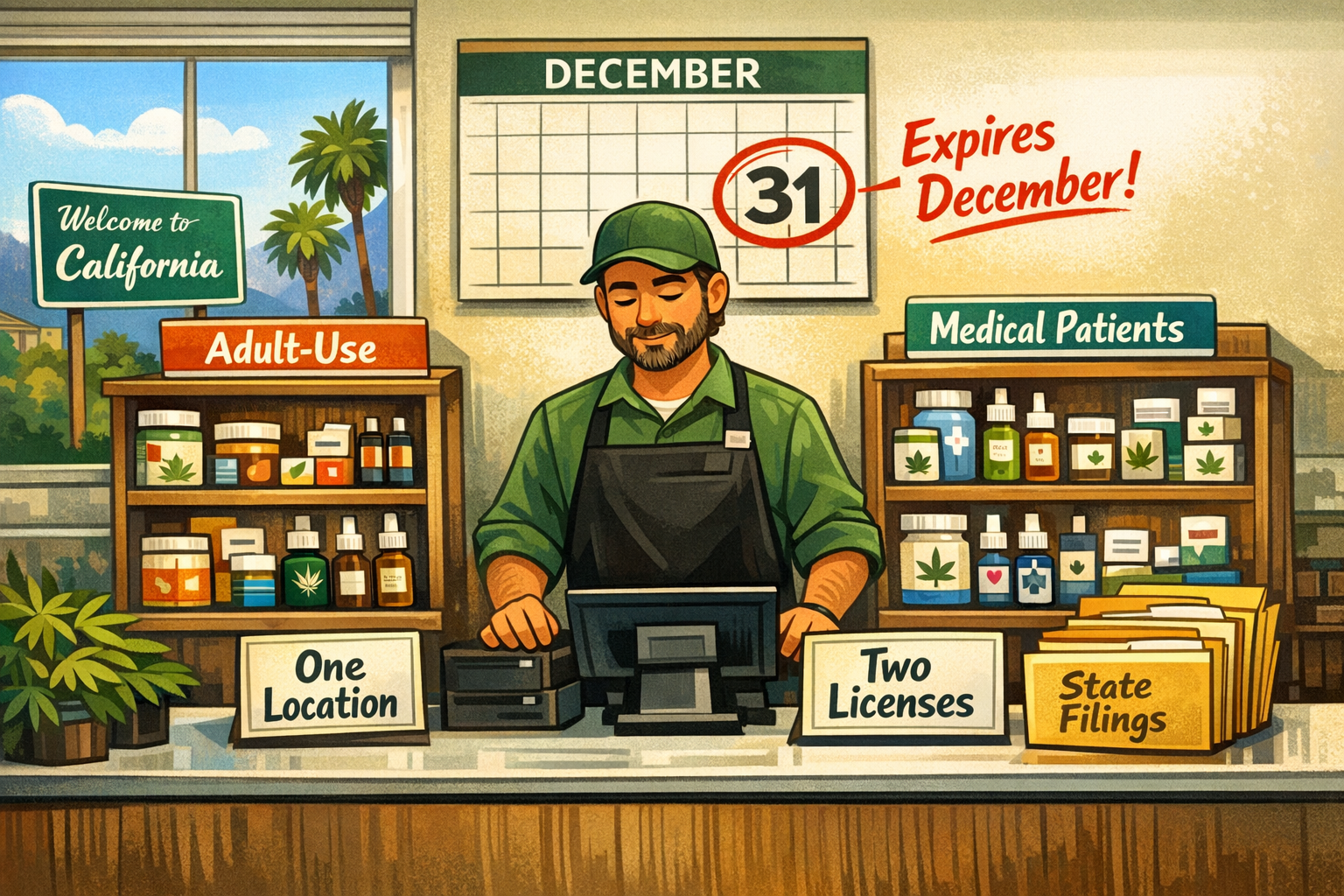
The California Department of Cannabis Control has several rulemaking actions advancing at once. An emergency rule, DCC-2026-03-E, was approved and filed with the Secretary of State on June 4, 2026, and is effective immediately. It creates a pathway for retailers to establish a second related entity and hold both an adult-use and a medicinal license at the same premises location. The emergency rule expires December 2, 2026. Separately, proposed regular rulemaking DCC-2026-02-R would update the state’s track-and-trace system by requiring all parties to a cannabis transfer to approve the transfer before a shipping manifest is generated, requiring retailers to enter certain tax information when recording sales, and requiring retailers to provide Certificates of Analysis to customers upon request. Public comment on DCC-2026-02-R remains open. A third proposal, DCC-2026-01-R, would establish multipacks as a new cannabis goods category with testing, labeling, and tracking requirements; that comment period closed April 13, 2026. The dual-license emergency rule gives retailers a limited window to structure adult-use and medicinal sales under one roof at a single location, but the pathway expires in December absent further action. The track-and-trace proposal still open for comment adds new compliance steps at the transfer and point-of-sale levels, including a formal obligation to furnish product testing documentation to customers on request.
Source:
https://www.cannabis.ca.gov/cannabis-laws/rulemaking/
CALIFORNIA: AG OPINION REQUIRES TRIBES TO HOLD STATE LICENSE FOR OFF-TRIBAL-LANDS CANNABIS ACTIVITY
California Attorney General Rob Bonta issued Opinion No. 25-102 on May 28, 2026, concluding that federally recognized Indian tribes located within California must obtain a commercial cannabis license from the California Department of Cannabis Control to conduct commercial cannabis activity with state licensees off tribal lands. The opinion applies the standard from Mescalero Apache Tribe v. Jones, finding that California’s licensing requirement is nondiscriminatory because it applies equally to all entities, and that no federal law or treaty reserves for tribes the right to engage in commercial cannabis activity off tribal land without a state license. A tribe applying for a DCC commercial cannabis license must submit a written waiver of any sovereign immunity defense it would otherwise hold in state administrative or judicial enforcement actions. According to Opinion No. 25-102, some states including Nevada, Washington, Michigan, and Oregon have addressed tribal market participation through government-to-government compacts, and California introduced similar bills in 2017 but none were enacted. The opinion makes clear that a tribe adopting cannabis regulations comparable to California’s framework does not substitute for a DCC-issued license. Any tribe seeking to sell, distribute, or otherwise conduct commercial cannabis activity with state-licensed businesses off its lands is now required to go through the state licensing process, including the sovereign immunity waiver requirement.
Source:
https://oag.ca.gov/system/files/opinions/pdfs/25-102.pdf
FEDERAL: DEA RESCHEDULING HEARING OPENS IN ARLINGTON AS GLASS HOUSE BRANDS LISTS ON NYSE
A Drug Enforcement Administration administrative law judge convened formal rescheduling proceedings in Arlington, Virginia, on June 29, with hearings scheduled through July 15 including a brief Independence Day recess. The hearing was initiated under President Trump’s December 2025 executive order and will determine whether all cannabis moves from Schedule I to Schedule III of the Controlled Substances Act, extending the scope of an April 2026 final order that covered only FDA-approved products and state-licensed medical cannabis. Government witnesses reportedly include a New Hampshire physician and an FDA official who will address the agency’s eight-factor scheduling analysis. Only opponents of rescheduling were invited to participate. A parallel constitutional challenge to the April order is proceeding in the D.C. Circuit. On the California side, Glass House Brands received NYSE approval on June 25 and was expected to begin trading under the ticker GLAS on June 30, becoming the second US plant-touching cannabis company to list on a major domestic exchange after Florida’s Trulieve Cannabis Corp., which listed in early June 2026. To meet NYSE listing requirements, Glass House deconsolidated its dual-use retail subsidiary and retained cultivation and wholesale operations under the listed entity. Chief Executive Kyle Kazan attributed the listing directly to the April 2026 reclassification of medical cannabis to Schedule III. A final rule extending Schedule III to all cannabis would relieve most state-licensed cannabis businesses from the Section 280E federal tax bar, which currently blocks deductions for ordinary business expenses. Glass House’s NYSE listing demonstrates that the April reclassification has already changed how some capital markets access US cannabis companies, even before any final rescheduling determination comes out of Arlington.
💼 Two San Diego Cannabis Opportunities – Flexible Structures Available
Opportunity #1 – Licensed Cannabis Campus, San Diego County (Ramona area)
Pricing: $2.2M for the property plus $800K for the license.
- Multiple local licenses covering Retail, Delivery, Distribution, Manufacturing, and Cultivation
- Approximately 2.7 acres with an existing 2,500 SF building and significant room to expand
- Operated as a retail dispensary through March 2025, generating $3M+ in revenue
- Positioned to benefit from a proposed San Diego County ordinance allowing on-site consumption and special events, opening new destination-style revenue streams
- Currently inactive, offering a turnkey licensed platform rather than starting from scratch
Opportunity #2 – San Diego City Retail License (Central San Diego)
Asking: $1.2M
- San Diego City retail license tied to an approximately 3,300 SF location
- Base rent of approximately $18,000 per month with excellent freeway access
- Adjacent to Costco and other major retail traffic generators, with strong demographics for storefront and delivery
- Close proximity to Downtown San Diego for efficient delivery logistics
- Plans submitted; approximately $500K in tenant improvements with a projected build out under 90 days once capital is in place
- Underwriting supports potential annual revenue of approximately $8 to $10M+, with meaningful upside through delivery and operational efficiencies. Seller will carry paper.
Seller is open to multiple transaction structures, including an outright sale, management partnership, joint venture, or other creative structures that maximize value for all parties.
The bottom line
Recent weeks brought concrete change to the California cannabis market, from the new dual-license pathway for retailers and Sonoma’s production-side tax cuts to a fresh retail application window in Shasta Lake. The AG’s tribal licensing opinion and the DEA hearing in Arlington round out a period where state-level rules and federal proceedings moved in parallel.
📬 Get Monthly Market Updates
Stay ahead of the curve with our monthly cannabis retail market newsletter. New markets, regulatory changes, and expansion opportunities delivered to your inbox.