NATIONAL CANNABIS RETAIL MARKET UPDATE, MAY 2026
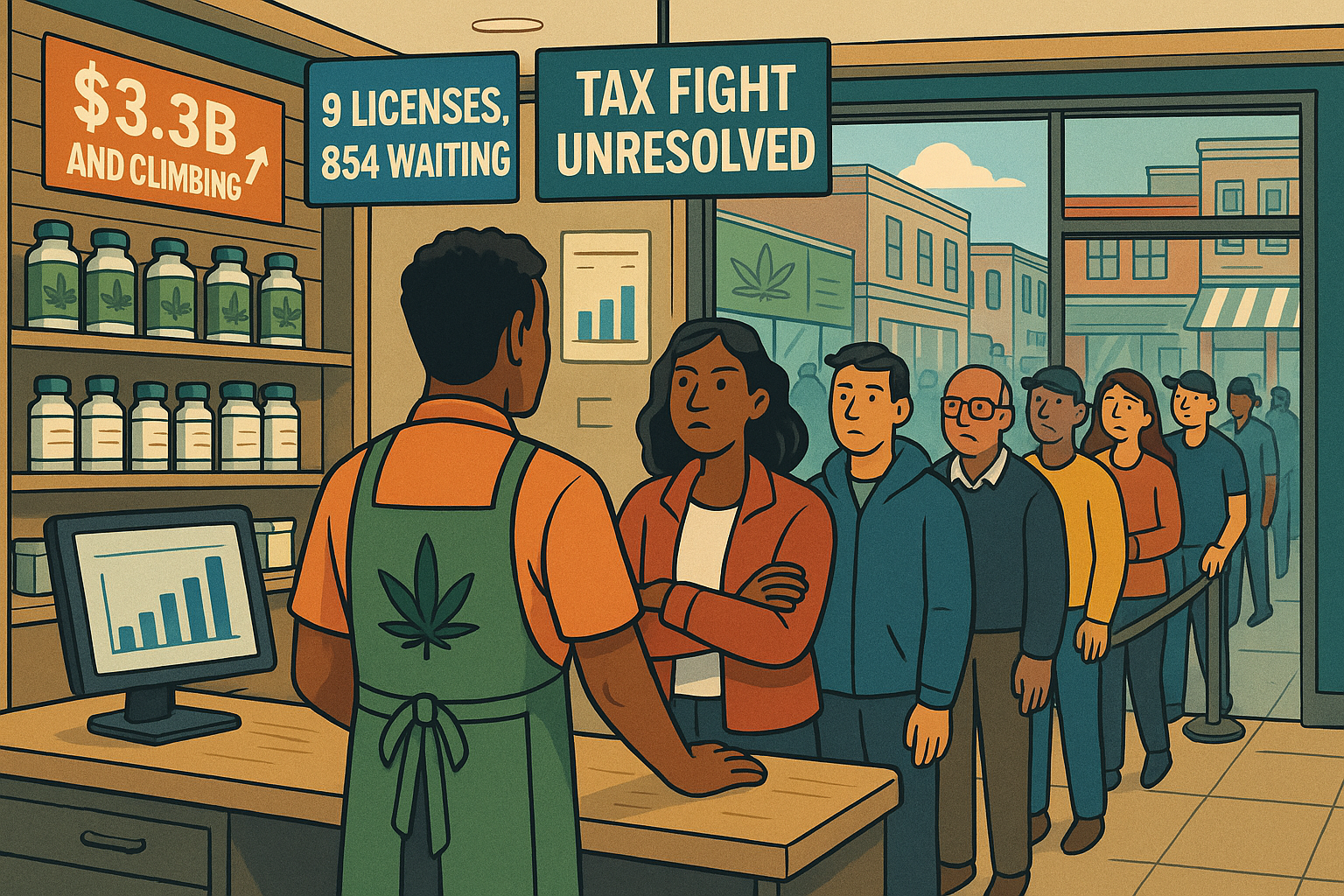
May 2026 cannabis state updates are landing across some of the biggest markets in the country, and the picture is anything but uniform. New York crossed $3.3 billion in cumulative sales and is now growing at 73.8% year over year, making it the most active expansion story in the country right now. Ohio hit $1 billion in cumulative recreational sales since its August 2024 launch while a hemp ban pushed 20 to 30% more customers into licensed dispensaries. Illinois is consolidating its dual licensing structure as a landmark social equity lottery dispute reaches its conclusion. Michigan is absorbing a sales decline tied to a contested wholesale tax. And Minnesota passed a sweeping omnibus bill that restructured cultivation rules and created a new macrobusiness license. Federal rescheduling of medical cannabis to Schedule III runs through all of it, reshaping the tax math for state-licensed businesses coast to coast.
Top Headlines This Month
- 📊 New York hits $3.3B in sales with 73.8% year-over-year growth
- 📊 Ohio SB 56 hemp ban drives 20-30% traffic surge to licensed dispensaries
- 🏛️ Illinois SB 4015 merges medical and adult-use dispensary licensing tracks
- 🏛️ Michigan files second wholesale tax suit as sales slide under the new levy
- 📋 Minnesota omnibus bill creates macrobusiness license, merges supply chains
📊 NEW YORK: $3.3B IN CUMULATIVE SALES AND 73.8% GROWTH DEFINE THE STATE’S RETAIL SURGE
New York’s licensed cannabis market reached $3.3 billion in total reported retail sales as of March 2026, generating $429 million in state excise tax revenue at the 13% rate set by the MRTA. Adult-use sales in 2025 alone hit nearly $1.8 billion, a 73.8% jump over the prior year, a growth rate that outpaces every major mature market, including California, which fell 2.7% to $4.8 billion, and Michigan, which dropped 2.3% to $3.18 billion over the same period. Retailers open for more than one year are averaging $3.95 million in annual sales, and 610 licensed dispensaries were operating statewide as of March 2026. Sales are heavily concentrated: OCM data through November 30, 2025 shows the top 10 stores account for 29% of statewide sales, and the top-performing 50% of stores generate roughly 80% of total revenue. Long Island alone accounted for 47% of annualized adult-use sales across New York’s 10 regions. Social and economic equity licensees represent 55% of all licenses and 77% of adult-use retail dispensaries, and a $6 million Equity Business Development Grant Program with awards up to $30,000 per licensee is expected to open its portal in Fall 2026. On enforcement, OCM closed 22 illegal shops in 2026 and seized more than $2 million in illicit cannabis products. Federal rescheduling of state-licensed medical cannabis to Schedule III landed on April 23, and Treasury and the IRS confirmed they will issue transition guidance treating the rescheduling as applying to the full taxable year, a direct financial benefit for New York’s licensed medical businesses. A microbusiness bill, Senate Bill 10113, filed April 30 by State Senator Michelle Hinchey, would allow microbusiness licensees to serve as both processor and cultivator at cannabis showcase events and has been referred to the Senate Investigations and Government Operations Committee.
New York’s May 2026 cannabis state updates confirm the market is still in an early expansion phase rather than approaching saturation. The concentration of sales among top stores and Long Island’s outsized share signal structural unevenness, and more than 50 lawsuits filed against OCM in the last 15 months show ongoing institutional friction. But the topline growth numbers make New York one of the most closely watched retail cannabis markets in the country right now.
Source:
https://rochesterbeacon.com/2026/05/07/the-highs-and-lows-of-legal-cannabis/
https://www.shankennewsdaily.com/2026/04/21/39663/cannabis-sales-exceeded-25-billion-in-leading-states-last-year/
https://cannabis.ny.gov/system/files/documents/2026/02/ocm-seizes-over-2-million-in-illicit-products.pdf
https://home.treasury.gov/news/press-releases/sb0471
📊 OHIO: SB 56 HEMP BAN PUSHES CUSTOMERS TO LICENSED DISPENSARIES AS CUMULATIVE ADULT-USE SALES PASS $1B
Ohio’s Senate Bill 56, signed by Gov. Mike DeWine in December 2025 and effective March 20, 2026, banned hemp products including beverages and tightened packaging rules prohibiting cartoon characters on cannabis packages. The law also authorizes future delivery services, though state guidelines have not yet been released. At licensed dispensaries, the shift is already measurable. Caveh Azadeh, owner of The Garden dispensary with locations in Camp Washington, Sycamore Township, and Dayton, reported customer counts up 20 to 30% since the changes took effect, attributing the increase to former hemp product buyers moving to regulated cannabis dispensaries and estimating the shift adds $200,000 to $300,000 in additional revenue per store. Both legal challenges to SB 56 are now closed: Ohioans for Cannabis Choice fell short of the 248,092 signatures needed for a November ballot referendum, and the Ohio Supreme Court dismissed a brewery lawsuit challenging the governor’s line-item veto of the hemp beverage carveout as SB 56 took effect on March 20. That removes the most plausible paths to reversal in the next year and locks in the demand shift toward licensed dispensaries. Separately, Ohio’s cumulative adult-use cannabis sales have surpassed $1 billion since the market’s August 2024 launch, and combined cannabis sales topped $1 billion in calendar 2025 alone. As of May 1, 2026, 137 of 163 municipalities that passed adult-use moratoriums remain active, covering approximately 14% of the state’s population. Ohio’s 10(B) dispensary licensing remains restricted to current medical cannabis license holders, with provisional license expiration deadlines now in view. The Ohio Supreme Court also ruled in early April that municipalities may immediately appeal trial court orders blocking enforcement of local ordinances, a procedural change that gives municipalities defending cannabis zoning restrictions faster access to appellate review.
Ohio’s cannabis retail framework in May 2026 is built around incumbents. The closure of both SB 56 legal challenges locks in the demand transfer from unregulated hemp retail to licensed dispensaries, which is a durable structural tailwind for existing license holders. The continued restriction of dual-use and 10(B) licensing to the medical pool means the retail license count is not expanding beyond those already in the system, and the provisional license expiration timeline is the next inflection point for the market.
Source:
https://local12.com/news/local/cincinnati-dispensary-owner-applauds-new-marijuana-law-dewine-senate-bill-56-garden-caveh-azadeh-hemp-cannabis-beverages-thc-law-packaging
https://moritzlaw.osu.edu/faculty-and-research/drug-enforcement-and-policy-center/research-and-grants/policy-and-data-analyses/ohio-marijuana-moratoriums
🏛️ ILLINOIS: SB 4015 MOVES TO MERGE MEDICAL AND ADULT-USE DISPENSARY LICENSING AS FINAL LOTTERY DISPUTE REACHES DECISION
Senate Bill 4015, amended March 5, 2026, would eliminate Illinois’s separate medical cannabis dispensary licensing pathway by deeming all medical dispensing organizations holding Early Approval Adult Use licenses to be adult-use dispensing organizations effective July 1, 2026. The transition would require a one-time $10,000 fee deposited into the Compassionate Use of Medical Cannabis Fund, with the first payment due October 1, 2026 and the Department permitted to approve payment plans extending beyond that date. Separately, purchases by qualified medical patients would be exempt from the Section 65-10 adult-use tax beginning July 1, 2026. The bill remained in the Cannabis and Intoxicating Products Subcommittee as of early April. Alongside the licensing consolidation, the final lawsuit from the 2020 social equity lottery reached a Cook County Circuit Court hearing during the week of April 1. The plaintiff, Well-Being Holistic Group, alleges that roughly 450 ineligible entries were allowed into a pool of 901 applicants for Chicago-region dispensary licenses, nearly doubling the pool and reducing the odds for other applicants. The state countered that even without the contested entries, Well-Being would have placed 126th out of 450 and would not have won a license. Judge Patrick Stanton was expected to issue a ruling at a hearing on May 21, 2026; as of late May the decision had not been publicly reported. As of January 2026, only 64% of licensed social equity dispensaries were operational, with nearly 100 sitting on unused licenses. A federal class action, Murray et al. v. Cresco Labs Inc. et al., was filed May 4 in the U.S. District Court for the Northern District of Illinois, targeting Cresco Labs, Green Thumb Industries, and Verano Holdings over alleged false marketing claims to recreational consumers across 12 states. IDOA’s proposed cannabis plant monitoring system and fee changes, published in fall 2025 with a public hearing held October 20, 2025, remain pending final adoption through the Illinois administrative rulemaking process.
SB 4015 represents one of the most significant structural changes to Illinois cannabis retail licensing since the dual-track system launched. Collapsing the medical and adult-use licensing tracks removes regulatory complexity but gives current medical license holders a tight window once the bill passes. The pending lottery ruling is an independent variable that could redraw the Chicago-region license map entirely, and the class action against three major Chicago-based multi-state companies adds litigation pressure at a moment when the state’s cannabis regulatory framework is already in motion.
Source:
https://www.ilga.gov/documents/legislation/104/SB/PDF/10400SB4015sam001.pdf
https://www.wqad.com/article/news/politics/illinois-politics/7-years-after-legalization-final-illinois-cannabis-licensing-lawsuit-goes-to-court/526-a42e460a-19da-4d97-92e1-59c00d3d8891
🏛️ MICHIGAN: WHOLESALE TAX LITIGATION COMPRESSES MARGINS AS SALES SLIDE UNDER THE NEW TAX
Michigan cannabis sales declined after the state’s 24% wholesale tax took effect January 1, 2026, under the Comprehensive Road Funding Tax Act. Official Cannabis Regulatory Agency data put February 2026 sales at $234.5 million, roughly a 3% decrease from February 2025, following January’s $226.8 million, which marked a near-16% month-over-month decline. Early projections from the analytics firm Headset had estimated February as low as $206.18 million, but the official CRA total came in higher. The Michigan Cannabis Industry Association, joined by grower Mitten Distro X LLC and retailer Refine Michigan Co., filed a second legal challenge to the tax on March 27, 2026, joining an earlier lawsuit that is now heading to trial after the Court of Claims declined to issue a stay. On April 22, 2026, the Michigan Supreme Court ordered the Court of Appeals to expedite its review of the tax. The association’s position is that the wholesale tax does not amend the Michigan Regulation and Taxation of Marihuana Act and therefore required no supermajority, while the state argues the same point in reverse. Michigan had 835 active adult-use dispensary licenses as of February 28, 2026. Separately, the Whitmer administration refused to release a four-page internal Cannabis Regulatory Agency memo from November 2023 that analyzed how additional taxes on marijuana would affect the cannabis industry, including whether they would push purchases toward the illegal market. That memo was delivered roughly 14 months before the wholesale tax was publicly proposed. The CRA also filed a second formal complaint on April 10 against Walled Lake-based Prism Triangle LLC, a state-licensed safety compliance lab, alleging peak shaving on delta-9 THC and THCA potency results, following a January complaint alleging peak shaving on pesticide and mold tests. Prism claims to be the largest testing lab in the state and has not requested a hearing on either complaint.
Michigan’s May 2026 cannabis state updates are defined by simultaneous pressure on margins, regulatory credibility, and market integrity. Retailers are absorbing the wholesale tax while it remains contested, and every brand or store that relied on Prism Triangle for compliance testing faces open questions about what those certificates of analysis actually certified. A trial in the first case is the earliest point at which the tax outcome could shift, and the Prism complaint trajectory mirrors the multi-year CRA case against Viridis Labs, which ultimately resulted in that lab’s closure.
Source:
https://www.cannabisbusinesstimes.com/us-states/michigan/news/15819825/michigan-cannabis-prices-remain-down-demand-steady-in-2026-despite-new-tax
https://www.michigan.gov/lara/news-releases/2026/04/10/press-release-cannabis-regulatory-agency-files-additional-new-formal-complaint-against
https://www.detroitnews.com/story/news/politics/2026/04/26/gretchen-whitmer-secret-memo-marijuana-tax-jocelyn-benson-southern-poverty-law-center/89770123007/
📋 MINNESOTA: OMNIBUS BILL CREATES MACROBUSINESS LICENSE AND MERGES MEDICAL AND ADULT-USE SUPPLY CHAINS
Minnesota passed HF4203/SF4401 this month, with the House approving it 92-42 and the Senate repassing it 34-33 after a House committee amendment. The bill eliminates the medical combination business license and creates a new cannabis macrobusiness license beginning January 1, 2027. It sets the indoor plant canopy limit for macrobusinesses at 38,000 square feet, down from a prior 90,000 square foot medical cannabis combination business limit, with the cap rising annually upon renewal up to a maximum of 45,000 square feet. The bill also removes the requirement that medical and adult-use cannabis be kept separate from seed to sale, allowing cultivators to grow both in the same facility. Medical patients continue to receive products tax-free with a medical card while recreational customers pay state taxes. Social equity provisions allow a person to hold up to four social equity licenses with up to 33% ownership per license. The Office of Cannabis Management released updated application data as of May 18 showing 3,541 total applicants across all cannabis license types with 213 licenses issued. The retailer category shows the widest gap: 854 total applicants against just 9 retail licenses issued. Recreational sales crossed $50 million since the September 2025 launch, and March 2026 recorded the highest single month at approximately $12 million. A Minnesota Court of Appeals ruling filed May 18 reversed the City of Albert Lea’s denial of a cannabis business registration, finding the city failed to follow its own first-come, first-served ordinance, though the court declined to order the registration issued because the city had amended the ordinance in February.
Minnesota’s cannabis licensing build-out is still in its earliest stages, with a retailer bottleneck at 9 licenses against 854 applicants being the clearest signal of how much runway remains. The omnibus bill’s merger of medical and adult-use supply chains removes a structural operational divide that had required cultivators to run parallel systems, lowering costs and accelerating the path to market for a program that generated $27 million in combined cannabis and hemp tax revenue in 2025. The Albert Lea ruling establishes that cities must follow their own registration ordinances rather than substitute policy opposition for the process the law requires.
Source:
https://www.house.mn.gov/sessiondaily/Story/19196
https://www.kttc.com/2026/05/18/appeals-court-reverses-albert-leas-denial-cannabis-business-registration/
Cannabis Retail & License Deals
Washington DC Medical Retail License Opportunity
Asking Price: $25,000
- DC medical cannabis retailer license eligible to be placed at any compliant property
- Seller will assist buyer with sourcing a compliant location
- Low cost entry opportunity into the expanding Washington DC regulated cannabis market
Peekskill, NY Retail Dispensary
Asking Price: $2,400,000
- Store opened August 2024
- $3M+ revenue last 12 months
- EBITDA $225K+
- 1,100 sq ft with option to add 1,100 sq ft upstairs for consumption lounge
- Located in downtown Peekskill near retailers, restaurants, and banks with great nearby parking
- Lease rate $2,700/month with 5-year term and 5-year extension option
Akron, OH Retail Dispensary
Asking Price: $4,000,000
- $5M revenue last 12 months
- EBITDA 15%
- 1,250 sq ft building
- Lease rate $8,500/month
Irvington, NJ Retail Dispensary
Asking Price: $400,000 or best offer
- Operational NJ dispensary on the border of Newark
- Former bank building connected to bus station with heavy foot traffic
- 1,344 sq ft retail space with full basement including bank safe, plus 500 sq ft office
- Lease rate $7,000/month gross
The Bottom Line
May 2026 cannabis state updates confirm a market sorting itself into distinct tiers. New York and Ohio are posting sales growth driven by market expansion and regulatory shifts that redirect consumer demand into licensed channels. Illinois is restructuring its licensing framework while a six-year-old lottery dispute reaches its final court decision. Michigan is absorbing the financial and legal fallout from a contested wholesale tax that remains unresolved in court. And Minnesota is methodically building a craft-oriented retail structure that still has more applicants than licenses across nearly every category. Federal Schedule III rescheduling of medical cannabis runs through all of it, and the June 29 DEA hearing on broader rescheduling is the next national milestone to watch.
📬 Get Monthly Market Updates
Stay ahead of the curve with our monthly cannabis retail market newsletter. New markets, regulatory changes, and expansion opportunities delivered to your inbox.