
Minnesota Cannabis Market Shifts in May 2026
Minnesota cannabis licensing in May 2026 hit several inflection points at once. The Office of Cannabis Management reported 213 licenses issued from 3,541 applicants, lawmakers passed an omnibus bill creating a new macrobusiness license and merging medical and adult-use supply chains, and the Court of Appeals reversed Albert Lea’s denial of a microbusiness registration. Tax revenue from 2025 cannabis and hemp sales topped $27 million, with regulators projecting monthly sales will eventually double.
PLUS: 10 cannabis-compliant retail sites secured across Minnesota. Browse MN sites → https://retail.cann.dev/mn (just enter your email to access)
AND: Multiple paper licenses available for acquisition.
Top Headlines This Month
- ⚖️ Appeals court reverses Albert Lea cannabis registration denial
- 🌱 New law lets cultivators grow medical and adult-use together
- 💰 Cannabis and hemp sales generate $27M in 2025 taxes
- 📊 OCM reports 213 licenses issued from 3,541 applicants
- 📋 Omnibus bill creates macrobusiness license starting January 2027
⚖️ APPEALS COURT REVERSES ALBERT LEA CANNABIS BUSINESS REGISTRATION DENIAL
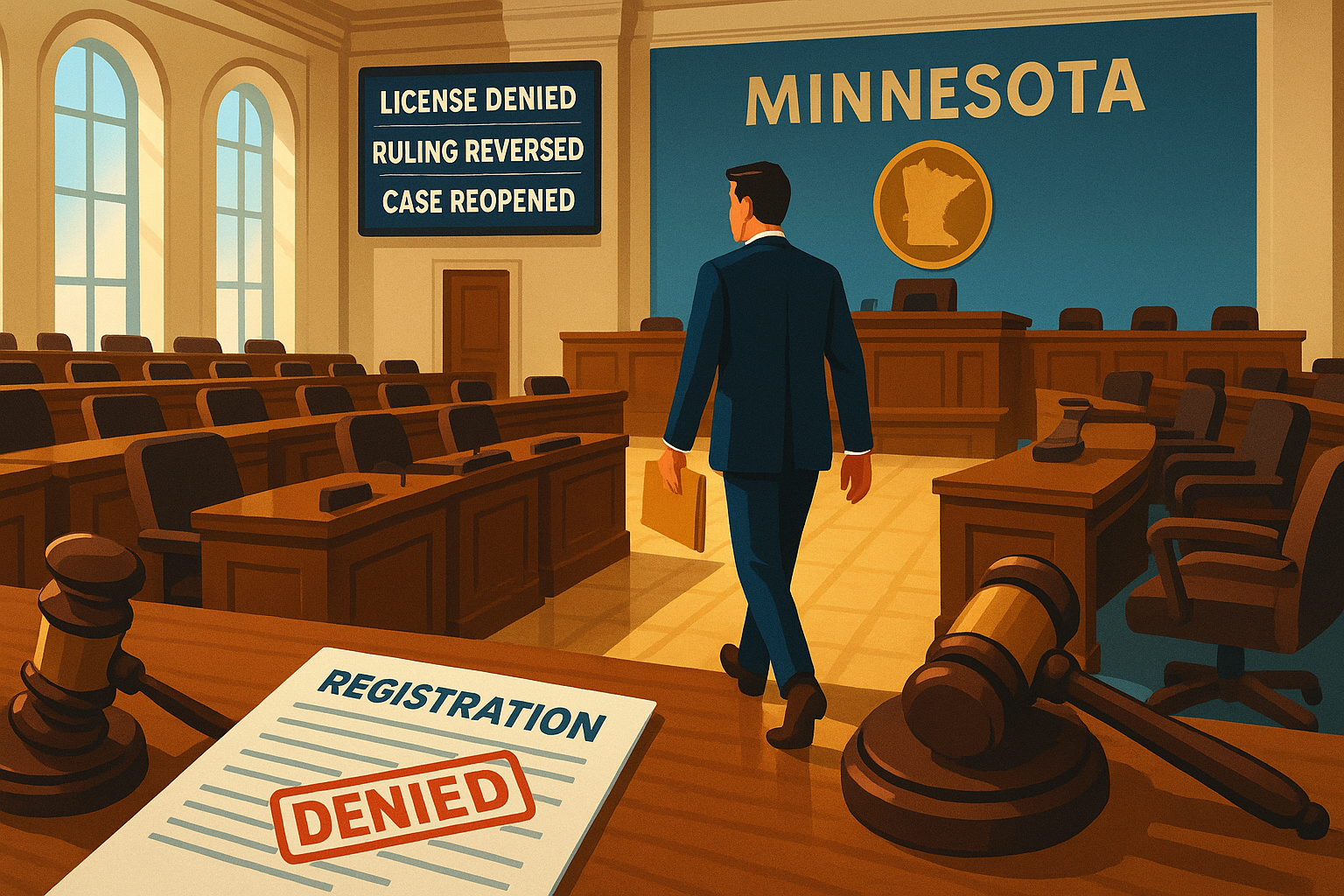
The Minnesota Court of Appeals reversed the City of Albert Lea’s denial of a cannabis business registration for Jacob Schlichter’s The Smoking Tree LLC, with Judge Lisa Beane’s opinion filed May 18 finding the city’s decision was contrary to law and made without reason. Schlichter was the first cannabis retailer licensed by the Office of Cannabis Management in the state, receiving his microbusiness license with a retail endorsement on July 17, 2025, and he applied for city registration the same day. The ordinance in effect at the time required registrations to be issued on a first-come, first-served basis based solely on a time-stamped OCM license, and city staff found his application complete under those criteria. The council voted 4-3 on July 28, 2025 to deny it, and according to court records that discussion centered on opposition to cannabis legalization and frustration with limits on local control rather than a review of the application itself. The narrow legal question before the court was whether the city followed its own ordinance, and the court found it did not. At the August 11, 2025 meeting the council approved two other cannabis applicants, filling both available registrations, and declined to reconsider Schlichter. The court reversed the denial but did not order Albert Lea to register him, because the city amended its cannabis ordinance in February 2026 and the record did not permit evaluation under the new rules.
The ruling is a narrow one. It establishes that a city cannot override its own first-come, first-served ordinance by substituting general opposition to legalization for a compliance review, but it is not an endorsement of the applicant. Separate from that legal question, members of the public and city staff raised concerns about Schlichter’s criminal history and conduct, and the city pointed to those concerns when it declined to reconsider his application in August. Albert Lea’s amended February 2026 ordinance now lets the council weigh background checks and business history, so the registration question remains unresolved and the case has a second chapter still to play out.
🌱 NEW LAW ALLOWS CULTIVATORS TO GROW MEDICAL AND ADULT-USE CANNABIS IN SAME FACILITY
A provision in Minnesota’s recently passed cannabis omnibus bill removes the requirement that medical and adult-use cannabis be kept separate from seed to sale. Cultivators can now grow both in the same facility. Eric Taubel with the Office of Cannabis Management said the change will help businesses operate more efficiently and get products to market faster. Under the new law, medical cannabis patients continue to receive products tax-free with a medical card, while recreational customers pay state taxes on the same cannabis products.
Removing the seed-to-sale separation between medical and adult-use cannabis eliminates a structural operational divide that had required cultivators to run parallel systems. The tax treatment distinction remains in place, preserving the patient benefit while allowing the production side to consolidate.
Source:
https://minnesotanewsnetwork.com/morning-headlines-may-25th-2026/
💰 CANNABIS AND HEMP PRODUCT SALES GENERATE $27M IN TAX REVENUE FOR 2025
Minnesota cannabis and hemp product sales generated more than $27 million in tax revenue in 2025, with monthly sales in the last three months of the year ranging from $9 million to $10 million. Nearly 180 businesses are licensed to operate in the state, a majority of them microbusinesses. Eric Taubel, executive director of the Office of Cannabis Management, said he expects sales to eventually double each month in the recreational market. The market has run into supply chain friction from insufficient in-state testing capacity, which led lawmakers to allow out-of-state testing to continue for hemp-derived THC products to relieve some of the pressure. One gram of cannabis flower costs about $13 before taxes, and regulators say they anticipate prices will go down as the market grows.
The combination of limited licensed retailers, constrained testing capacity, and a craft-focused microbusiness licensing structure has produced a slower market ramp than some expected. Taubel’s projection that monthly sales will eventually double signals meaningful room for growth, though the current pace reflects the structural choices built into Minnesota’s licensing framework from the start.
Source:
https://www.northernnewsnow.com/2026/04/04/legal-weed-earns-minnesota-27m-tax-revenue-2025/
📊 OCM DATA SHOWS 213 CANNABIS LICENSES ISSUED FROM 3,541 TOTAL APPLICANTS
Minnesota’s Office of Cannabis Management released updated cannabis business application data as of May 18, 2026, showing 3,541 total applicants across all cannabis license types with 213 licenses issued. Microbusinesses represent the largest applicant pool, with 1,854 total applications and 162 licenses issued. The retailer category shows a notable gap between demand and approvals: 854 total applicants with just 9 retail licenses issued to date. Other license types include 273 mezzobusiness applicants with 8 licenses issued, 96 cultivator applicants with 4 licenses issued, and 18 testing facility applicants with 5 licenses issued. OCM notes the data are preliminary and subject to change, and denied applicants have 10 days to request reconsideration of their application.
The retailer pipeline represents a notable bottleneck in the data, with 854 applicants and only 9 licenses issued. The gap across nearly every license type reflects how early the state’s cannabis licensing build-out remains, and the numbers will continue shifting as OCM works through its application review queue.
Source:
https://mn.gov/ocm/data-reports/application-data/
📋 OMNIBUS CANNABIS BILL CREATES MACROBUSINESS LICENSE, MERGES MEDICAL AND ADULT-USE SUPPLY CHAINS
Minnesota passed HF4203/SF4401 this month, with the House approving it 92-42 and the Senate repassing it 34-33 after a House committee amendment. Sponsored by Rep. Jessica Hanson (DFL-Burnsville) and developed through collaboration with more than 80 stakeholders over three months, the bill eliminates the medical combination business license and creates a new cannabis macrobusiness license beginning January 1, 2027. It sets the indoor plant canopy limit for macrobusinesses at 38,000 square feet, down from the prior 90,000 square foot medical cannabis combination business limit, with the macrobusiness cap able to rise annually upon renewal up to a maximum of 45,000 square feet. It removes the ratio requiring license holders to grow a certain ratio specifically for medical cannabis, and requires macrobusinesses to keep identified medical cannabis products in stock while requiring other cannabis businesses to provide those products within 24 hours of a request. On social equity, the bill allows a person to hold up to four social equity licenses with up to 33% ownership per license. The bill also allows hemp business license holders to hold cannabis licenses, providing a bridge for hemp businesses facing a federal ban on products containing more than 0.4 milligrams of THC that takes effect November 12, 2026.
The shift to a single macrobusiness license structure removes the separate medical grow ratio that had constrained cultivation planning for larger businesses. The indoor canopy reduction from 90,000 to 38,000 square feet drew sharp criticism from Rep. Nolan West, who warned the cut could invite litigation, so the new limits will face real-world pressure as businesses adjust ahead of the January 1, 2027 effective date.
Source:
https://www.house.mn.gov/sessiondaily/Story/19196
💼 Real Estate & Licensing Opportunities in Minnesota
Retail Locations — 10 Cannabis-Compliant Sites Across Minnesota
- 10 cannabis-compliant retail locations secured across Minnesota
- Elk River: capped market (3 only), local license in hand, site secured, option to move locations
- Browse MN sites → https://retail.cann.dev/mn (just enter your email to access)
Paper Licenses Available
- SEE Retail @ $100k
- SEE Mezzo @ $200k
- General Mezzobusiness @ $500k
- General Microbusiness @ $25k-$35k
- General Transport @ $100k
- General Wholesale @ $100k
- General Transport + Wholesale @ $150k
- General Delivery @ $100k
- General Manufacturing @ $500k
The Bottom Line
May 2026 reshaped Minnesota cannabis licensing on multiple fronts, with the omnibus bill restructuring cultivation rules, OCM data showing a clear retailer bottleneck at 9 licenses against 854 applicants, and an appeals court ruling that cities must follow their own registration ordinances rather than substitute policy opposition for the process the law requires. The state’s cannabis market is still ramping, but the structural pieces are moving into place.
📬 Get Monthly Market Updates
Stay ahead of the curve with our monthly cannabis retail market newsletter. New markets, regulatory changes, and expansion opportunities delivered to your inbox.