
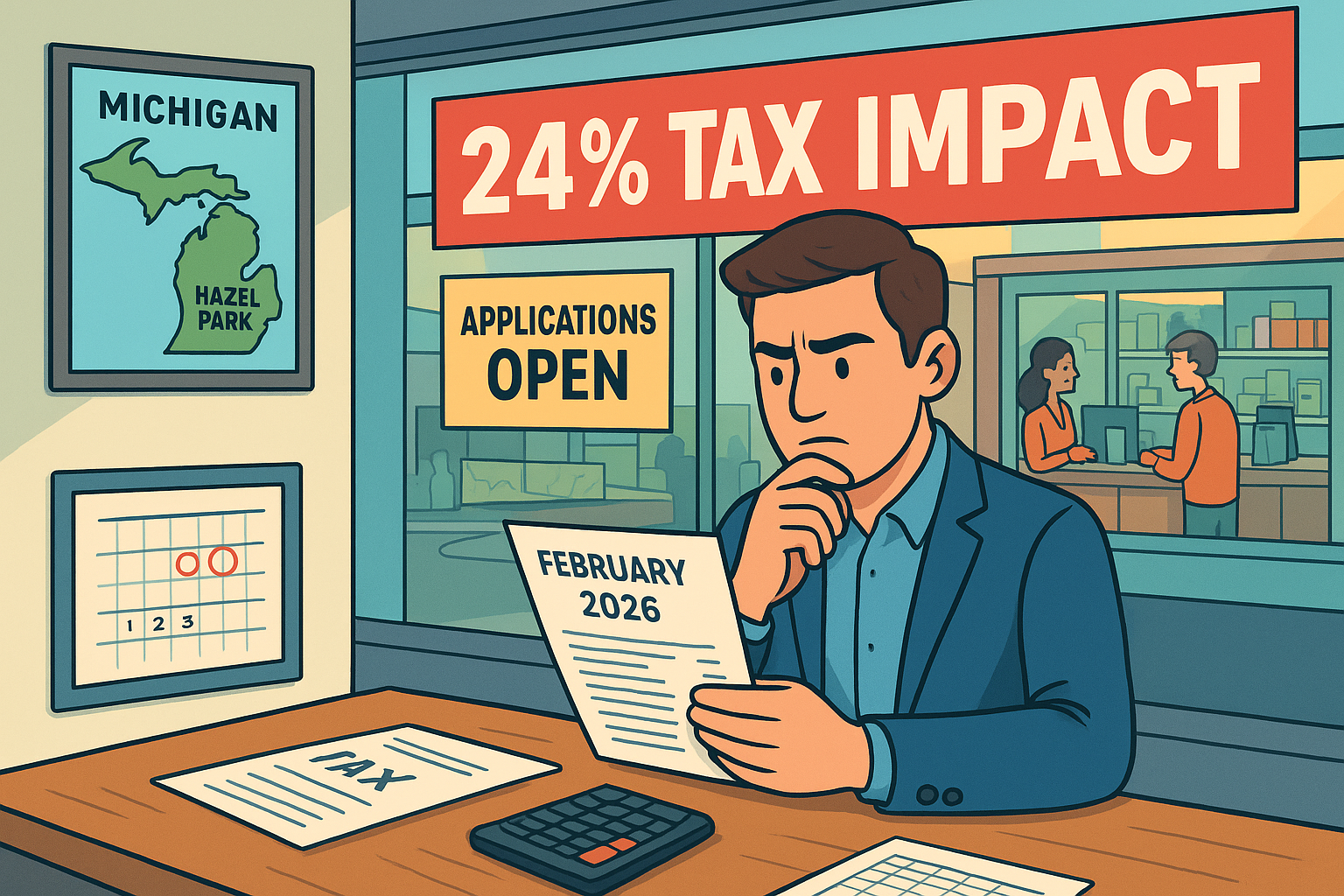
Michigan Cannabis Retail Market Update – February 2026
Michigan cannabis retail licensing faces significant changes in February with the new 24% wholesale cannabis tax taking effect January 1, Hazel Park opening a 30-day application window for multiple facility types, and a proposed bill potentially limiting retail licensure in the future. The wholesale tax adds substantial cost pressure to the supply chain, making every new market opening, remaining license slot, and active application window more valuable. If you’re positioning for market entry in Michigan’s cannabis market, February brings distinct opportunities amid increasing regulatory complexity.
Top Headlines This Month
- 💰 24% wholesale cannabis tax takes effect statewide January 1
- 📋 Hazel Park opens 30-day application window for cultivation, processing, labs
- ⚖️ Proposed SB 597 would limit retail licenses to 1 per 5,000 residents
- 🏙️ Lincoln Park approves relocation amendment for two existing retailers
- 📊 Industry faces increased cost pressure from new tax structure
💰 Statewide – 24% Wholesale Cannabis Tax Takes Effect
The Setup:
Michigan’s new 24% wholesale cannabis tax took effect January 1, 2026, under the Comprehensive Road Funding Tax Act (CRFTA). The tax applies to adult-use cannabis products when sold or transferred from licensed growers or processors to retailers, adding to the existing 10% retail excise tax and 6% sales tax.
The Impact:
The wholesale tax creates a stacked tax burden of up to 40% across the supply chain, potentially increasing consumer prices by 20-30%. Cannabis businesses now navigate three tax layers: the new 24% wholesale tax, the existing 10% retail excise tax, and standard 6% sales tax. The tax targets the entity making the first sale or transfer to a retail licensee, affecting cultivators and processors selling to dispensaries.
The Opportunity:
Vertically integrated operations may gain competitive advantages by controlling more of the supply chain internally. Retailers should evaluate supplier relationships and pricing strategies to manage increased wholesale costs. Cultivation and processing licenses become more valuable as entry points for businesses seeking to control costs through vertical integration.
Strategic Angle:
Focus on vertical integration opportunities or strategic partnerships that can help absorb the tax impact. Monitor how competitors adjust pricing and identify opportunities to gain market share through efficient cost management.
📋 Hazel Park – 30-Day Application Window Open for Multiple Facility Types
The Setup:
Hazel Park opened a 30-day application window January 20 running through February 19 for marijuana city operating licenses covering secure transportation, safety compliance labs, processing, and cultivation. Applications require payment to the Treasurer, submission to the City Clerk in sealed envelopes with paper copy and USB drive, and Special Land Use approval.
The Impact:
Hazel Park’s application window targets non-retail license types but signals active municipal licensing in a market that already allows retail operations. The cultivation and processing licenses feed the supply chain for existing retailers and position applicants for vertical integration opportunities. With the new 24% wholesale tax, cultivation and processing licenses become more valuable as pathways to control supply chain costs.
The Opportunity:
If you’re operating retail in metro Detroit and need vertical integration, Hazel Park’s cultivation and processing window runs until February 19. Special Land Use approval adds 60-90 days to the timeline, so applicants should engage planning staff immediately to confirm site eligibility and zoning compliance. Hazel Park’s 16,000 population and proximity to I-75 create distribution advantages for serving the Detroit retail corridor.
Strategic Angle:
Submit applications before February 19 and start Special Land Use discussions with planning staff this week. Early site control in industrial zones increases approval odds.
⚖️ Proposed Legislation – SB 597 Could Limit Retail Licensing
The Setup:
Proposed Senate Bill 597, introduced by Senator Sam Singh in October 2025, would prohibit the Cannabis Regulatory Agency from issuing new marijuana retailer licenses if doing so would result in more than one retailer for every 5,000 residents in a municipality. The bill also proposes freezing new licenses for Class B and C cultivation operations, testing labs, and transport companies.
The Impact:
If passed, SB 597 would create significant restrictions on new retail licensing statewide, potentially creating regional monopolies or oligopolies for existing dispensaries. The legislation aims to address market oversupply and increased competition that has driven down wholesale prices. Critics argue it would limit new business entry and reduce competition.
The Opportunity:
Monitor the legislative progress of SB 597 closely. If the bill advances, existing license holders in markets that would exceed the population ratio could gain significant competitive protection. New market entrants should focus on municipalities that would remain under the proposed limits or pursue acquisition strategies for existing licenses.
Strategic Angle:
Track municipalities that would be affected by the population-based licensing caps. If you’re planning new retail entry, prioritize markets that would remain open under the proposed restrictions or accelerate existing application processes before potential restrictions take effect.
🏙️ Lincoln Park – Council Approves Relocation Amendment for Existing Retailers
The Setup:
Lincoln Park City Council voted 4-3 on January 26 to amend the city’s cannabis ordinance, allowing the city’s two retailers, Pleasantrees and Moses Roses, to relocate from an industrial area on John Papalas Drive to the municipal business district along Dix Highway, Southfield Road, and Fort Street. The retailers cited safety concerns in the industrial zone after 5 p.m. when neighboring businesses close.
The Impact:
The amendment creates relocation pathways for existing operators without opening new license slots, preserving Lincoln Park’s 2-license cap while improving site flexibility. Mayor Maureen Tobin stated any relocation would require multi-department review to ensure compliance with all ordinances. The move signals municipalities may address site-level issues through amendments rather than cap increases.
The Opportunity:
For operators in Michigan municipalities with restrictive zoning, Lincoln Park’s amendment creates a precedent for site flexibility ordinances that don’t increase license counts. If your retail license sits in an industrial zone with limited traffic or visibility, engage city councils on relocation amendments before Q2 2026 budget cycles.
Strategic Angle:
Document safety or access concerns at your current site and present relocation proposals tied to business district improvements. Frame requests as site optimization, not cap increases, to avoid potential legislative concerns.
The Bottom Line
February brings significant changes to Michigan cannabis retail licensing: the new 24% wholesale tax taking effect January 1 creates substantial cost pressures across the supply chain, Hazel Park’s active cultivation and processing window closes February 19, and proposed legislation SB 597 could fundamentally reshape retail licensing if passed. The wholesale tax makes vertical integration more valuable, while Hazel Park offers immediate opportunities for supply chain control. If you’re positioning for Michigan market entry, prioritize Hazel Park applications before February 19, monitor SB 597’s legislative progress, and evaluate vertical integration strategies to manage the new tax burden.
📬 Get Monthly Market Updates
Stay ahead of the curve with our monthly cannabis retail market newsletter. New markets, regulatory changes, and expansion opportunities delivered to your inbox.