
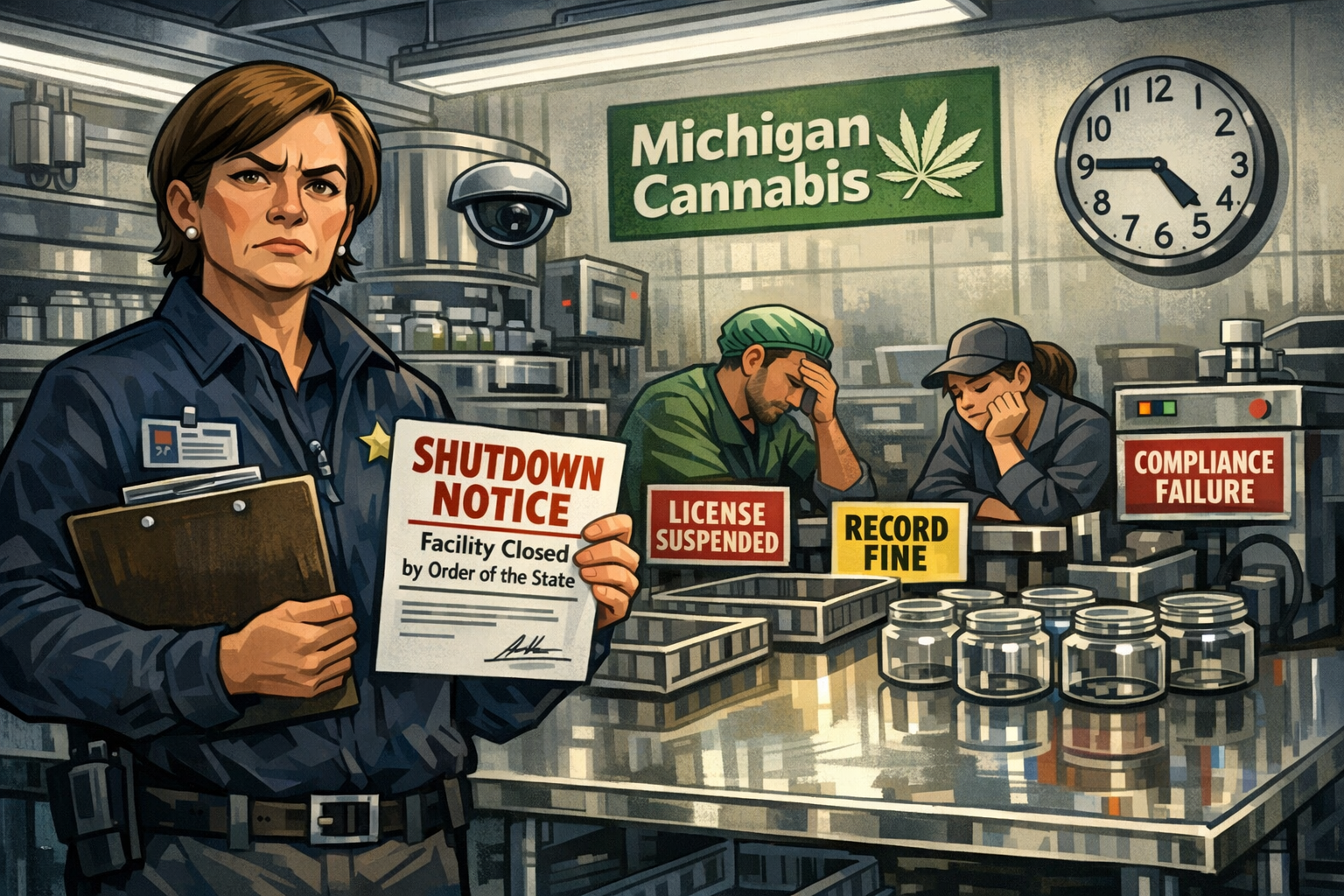
MI Monthly Puff: Record $2M Fine, Court Voids $31.8M Cannabis Judgment
Michigan cannabis enforcement September 2026 was defined by heavy regulatory action and courtroom reversals. The CRA issued a record $2 million fine and shut down the licensed manufacturer behind Muha Meds, while the Sixth Circuit erased a $31.8 million cannabis contract judgment against Curaleaf subsidiaries. City-level fights over dispensary caps, parking lot compliance, and tribal-land licensing rounded out a month where the rules got sharper on every front.
Top Headlines This Month
- Menominee voters decide November 3 on raising cap to 13
- Mount Clemens gives Joyology 30 days before permanent revocation
- Hempire Collective opens first dispensary on Saginaw Chippewa land
- Sixth Circuit voids $31.8M cannabis contract judgment
- CRA issues record $2M fine, shuts Muha Meds producer
Menominee: November Vote Could Raise Dispensary Limit from 9 to 13
Menominee residents will vote on November 3 on whether to increase the city’s marijuana dispensary cap from 9 to 13 licenses. Supporters of the ballot measure submitted well over the minimum number of petition signatures required under Michigan law. A group called ‘Menominee’s Not For Sale’ challenged the measure, arguing the petition failed to satisfy state legal requirements, but Judge Mary Barglind ruled Monday that the petition met Michigan election law standards and cleared it for the November 3 ballot. This is not the city’s first time setting a dispensary limit. In 2025, voters approved a measure capping dispensaries at nine, and multiple lawsuits followed involving licensing decisions and cannabis business applicants. The legal fight to keep the measure off the ballot reflects how contested dispensary licensing has become in Menominee. Whether the cap rises to 13 or holds at 9, the November vote will set the licensing ceiling for a market that has already generated sustained litigation since its current limit was established.
Source:
https://www.uppermichiganssource.com/2026/09/22/november-vote-could-increase-marijuana-dispensaries/
Mount Clemens: Joyology Cannabis Faces Permanent License Revocation Over Parking Lot Non-Compliance
Mount Clemens city commissioners tabled Joyology Cannabis Dispensary’s business permit renewal on September 21 after the shop, which opened on Malow Street, failed to build a required parking lot despite operating for more than a year. The parking lot work was supposed to begin in April, but Joyology missed that deadline and provided no communication to city staff about the delays. As months passed with no sign of progress, the city revoked the temporary occupancy permit. The company then produced a contract and promised to finish the lot by August 2026, but missed that deadline as well. The commission gave Joyology 30 days to show significant and meaningful progress on the project, which the company estimates will take six to eight weeks to complete. If progress is not demonstrated, commissioners said they will likely revoke the license permanently, which would close the business in Mount Clemens. The commission also plans to notify the Michigan CRA of the situation. The CRA can fine the company between $5,000 and $15,000 per month until the license is renewed, adding potential state-level financial penalties on top of the city’s revocation threat. Joyology also operates dispensaries in Center Line and Lake Orion.
Mt. Pleasant: Hempire Collective Opens First Dispensary on Saginaw Chippewa Tribal Land
The Hempire Collective opened its newest dispensary at 2410 South Leaton Rd., next to Soaring Eagle Casino on the Saginaw Chippewa Indian Tribe’s reservation in Mt. Pleasant, on Saturday, September 26, with a ribbon-cutting ceremony. The family-owned, vertically integrated company faced regulatory complications tied to the location’s tribal and federal land status that caused delays before the opening. The process required multiple waivers and Michigan attorney general authorization before the CRA would approve the license. The Hempire Collective had initially planned to pay the tribe a higher percentage of profits but reduced that agreement to resolve outstanding CRA issues. This is the first dispensary on the reservation and one of several cannabis dispensaries in Mt. Pleasant. Tribal members receive a discount on all products. Mt. Pleasant generated significant cannabis tax revenue this year, and Isabella County received substantial state tax disbursements from its licensed businesses. The Hempire Collective’s experience shows that opening on tribal land in Michigan adds months of regulatory work beyond the standard licensing process, including steps at the state attorney general level that typical applicants do not face.
Federal: Sixth Circuit Reverses $31.8 Million Cannabis Contract Judgment Against Curaleaf Subsidiaries
The Sixth Circuit Court of Appeals in Cincinnati reportedly reversed a $31.8 million breach of contract judgment that Hello Farms Licensing MI, LLC had won against Curaleaf Holdings subsidiaries GR Vending MI, LLC and CURA MI. Hello Farms had contracted to sell its full 2020 and 2021 cannabis harvests at an agreed price per pound. GR Vending MI paid a $2.2 million deposit and accepted a first shipment of roughly 2,000 pounds, but when cannabis prices in Michigan dropped sharply in January 2021, the company refused additional deliveries. Hello Farms harvested 16,300 pounds in 2020 and 37,500 pounds in 2021, and was forced to sell at lower prices under other contracts. A federal jury initially awarded Hello Farms $31.8 million, but the appeals court ruled that federal courts cannot enforce contracts for activities that remain federal crimes, regardless of state legalization. The court also rejected Hello Farms’ argument that the Rohrabacher-Farr amendment shielded the agreement, stating that the contract itself required Hello Farms to possess cannabis with intent to distribute, which is a federal crime. The ruling establishes a concrete legal risk for cannabis cultivation and distribution contracts in Michigan and across the Sixth Circuit’s jurisdiction. Any cannabis supply contract that requires possession and distribution of marijuana is, under this decision, unenforceable in federal court, leaving parties with disputes over failed agreements without a federal remedy regardless of what state law allows.
Michigan: CRA Issues Record $2 Million Fine and Shuts Down Muha Meds Producer
Michigan Investments 10 Inc., a Pinconning-based manufacturer of Muha Meds cannabis products, will be shut down by the Michigan Cannabis Regulatory Agency on September 24 and is ordered to pay a record $2 million fine. The CRA accused the company of violations dating back to 2022, including surveillance and inventory-tracking failures, testing noncompliance, unapproved business agreements, and security lapses. Among the violations cited was an extraction room camera pointed at a wall instead of the activity it was supposed to monitor. The CRA suspended the company’s licenses in November 2023, but an administrative law judge lifted that suspension in January 2024 after hearings, allowing the company to keep operating. On June 18, the same judge ruled that evidence supported all 31 violations the CRA filed in 2023, resulting in the $2 million fine and license closures. The company’s compliance manager called the fine unprecedented and said the company may appeal, citing ongoing litigation. Muha Meds, founded in 2019 by brothers Ali and Muhammad Garawi, generates an estimated $175 million in annual revenue from products sold in California, Michigan, Missouri, and New York. Michigan law requires cannabis sold in the state to be grown, processed and manufactured by Michigan-licensed businesses, so the shutdown of Michigan Investments 10 removes the licensed manufacturer behind the state’s Muha Meds supply. Two Muha Meds retail stores in Detroit and Ypsilanti maintain active licenses, and Muha Meds products remain available at stores across Michigan.
The Bottom Line
Michigan cannabis enforcement tightened across the board in September 2026, with a record state fine, a federal appeals ruling that strips contract remedies from cultivation deals, and local disputes over caps and compliance. Every layer of the Michigan marijuana industry, from tribal-land licensing to municipal parking requirements, is being tested at once.
📬 Get Monthly Market Updates
Stay ahead of the curve with our monthly cannabis retail market newsletter. New markets, regulatory changes, and expansion opportunities delivered to your inbox.