
Want to enter this market?
Massachusetts is adult-use and medical and takes applications year-round, so the way in is a site with a host community agreement
Massachusetts Cannabis Retail
Entering Massachusetts
OpenLast updated 11 November 2026
Adult-use and medical. Voters approved adult-use cannabis by ballot measure in November 2016 and the first two stores opened two years later; the Cannabis Control Commission regulates both programs, and the industry now has nearly 800 operating businesses. Chapter 65 of the Acts of 2026, signed on 19 April 2026, restructured the Commission and changed the cannabis laws.1, 4
- License types and caps
- Adult-use Marijuana Establishments: retailer, cultivator (indoor or outdoor), craft marijuana cooperative, product manufacturer, microbusiness, marijuana courier, marijuana delivery operator, social consumption establishment, transporter, research facility, independent testing laboratory and standards laboratory. Medical: the fully integrated medical treatment center (grows, processes and sells its own products), the only medical type so far. Cap: no one may control more than six retailer licenses, three medical treatment centers, three product manufacturer or three cultivator licenses (three of any other class).2, 3, 4
- Application window
- Open on a rolling basis. The Commission must issue or reject a complete application within 90 days, and the usual adult-use process takes about three months from application to approval; the applicant also needs a host community agreement with the city or town. Delivery operator and courier licenses stay reserved for Social Equity Program participants and Economic Empowerment applicants until 1 April 2029; the Social Equity Program is taking applications until 30 November 2026.5, 6, 7, 3, 9
- Local opt-out
- Yes. A city or town may set the time, place and manner of operations, limit the number of marijuana businesses, and restrict signs. Banning a type of business, or capping retailers below 20 percent of its package-store liquor licenses, needs a local vote first in towns that voted yes on the 2016 ballot question (and in every town after 2019). A marijuana business may not be within 500 feet of an existing school unless the town lowers that distance. Every business signs a host community agreement, whose community impact fee is capped at 3 percent of gross sales for the first eight years. Delivery is allowed everywhere unless a town with no retail licenses gets a two-year waiver.7, 5, 8
Ownership and social equity, taxes, delivery and testing, upcoming changes and the numbered sources are in the Massachusetts rules panels on this page.
CannDev is evaluating the Massachusetts market to find the best locations for adult-use retailers. The Commission takes applications on a rolling basis, but every business needs a host community agreement with its city or town, so the way in is a site where the town will sign one. Please sign up for our Off Market Deals to be included in our alerts where you can get first look at new real estate opportunities in Massachusetts.
Latest Massachusetts News
Latest regulatory update
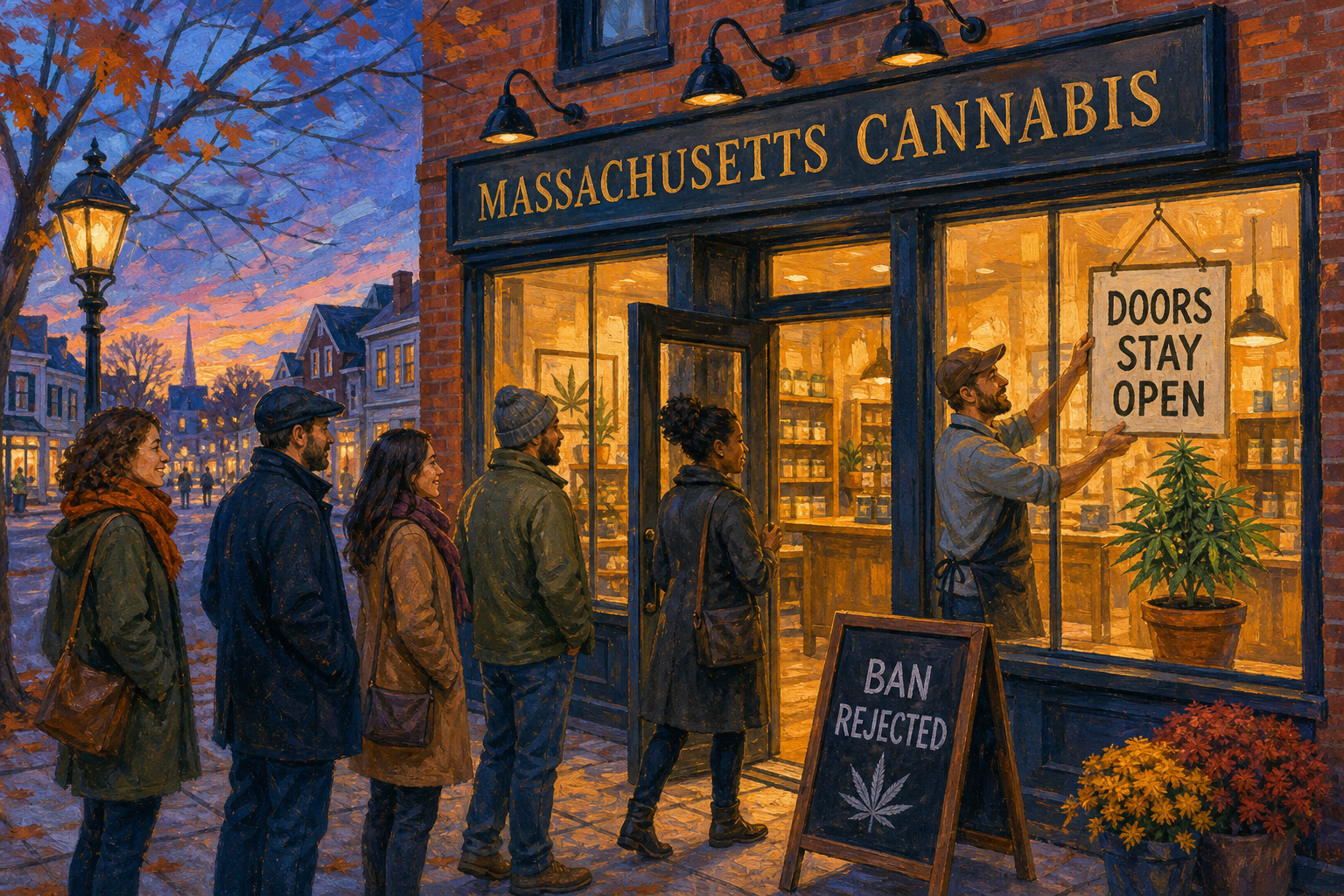
Massachusetts cannabis Question 8 failed at the polls, 2026 sales topped $1.51B through October, and SNDL raised its Parallel stake to 92%.
Regulatory Detail
No person or entity with direct or indirect control may hold more than six retailer licenses (raised by Chapter 65 of 2026); until 12 months after the Commission starts taking applications under the new cap, a business that is not a social equity business may get no more than five. A controlling person may not have a felony conviction, except one solely for marijuana or simple possession. The Social Equity Program, open to people from communities hit hardest by the War on Drugs, gives fee waivers, pre-certification and exclusive access to delivery and social consumption licenses; participants may also get grants and loans from the state's Cannabis Social Equity Trust Fund.3, 4, 5, 9, 10, 13
- Delivery: delivery operators and couriers bring cannabis to consumers' homes; these licenses are reserved for social equity and economic empowerment businesses until 1 April 2029.
- Testing: every product is tested by an independent laboratory for cannabinoids and contaminants (mold, mildew, heavy metals, plant growth regulators, pesticides); results are good for one year.
- Packaging: all products sold to consumers must be in child-resistant packaging.
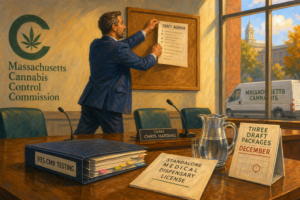
- Proposed: The Commission plans to vote in December on three sets of draft regulations (a standalone medical dispensary license, a new cannabis testing section, how towns may opt out of delivery, whether to consider statewide license caps, and more), take public comment and hold a hearing in early 2027, and take a final vote in March.13
- Proposed: Commissioners discuss the draft testing regulations for independent testing laboratories; public comment opens in early 2027.14
- In effect: Emergency regulations raised the retail ownership cap to six licenses, as Chapter 65 of the Acts of 2026 requires.13
- Cannabis Control Commission, Recognizes 10 Years of Adult-Use Cannabis in Massachusetts (October 2026) (regulator, seen 11 November 2026)
- Cannabis Control Commission, License Types (regulator, seen 11 November 2026)
- 935 CMR 500.000 Adult Use of Marijuana (effective 11 September 2026), Cannabis Control Commission (regulator, seen 11 November 2026)
- Chapter 65 of the Acts of 2026, An Act Modernizing the Commonwealth's Cannabis Laws (statute, seen 11 November 2026)
- M.G.L. c.94G section 5: licensing of marijuana establishments (statute, seen 11 November 2026)
- Cannabis Control Commission, Adult-Use Applicants (regulator, seen 11 November 2026)
- M.G.L. c.94G section 3: local control (statute, seen 11 November 2026)
- M.G.L. c.94G section 4: Cannabis Control Commission powers (statute, seen 11 November 2026)
- Cannabis Control Commission, Apply Now to Join the Social Equity Program (regulator, seen 11 November 2026)
- Cannabis Control Commission, Equity Programs (regulator, seen 11 November 2026)
- M.G.L. c.64N section 2: state marijuana excise (statute, seen 11 November 2026)
- M.G.L. c.64N section 3: local marijuana sales tax (statute, seen 11 November 2026)
- Cannabis Control Commission, Kicks Off Major Regulatory Overhaul (September 2026) (regulator, seen 11 November 2026)
- Cannabis Control Commission, to Review Draft Testing Regulations (October 2026) (regulator, seen 11 November 2026)
Sign up for
The CannDev Monthly Puff Newsletter
Our once-a-month briefing on each cannabis market you pick: new licenses, rule changes, store openings and retail real estate locations we have available.