CA Monthly Puff: California Cannabis Labor Peace Rule Revived
Top Headlines This Month
- 📋 Ninth Circuit revives cannabis labor peace challenge
- 📋 Q3 cannabis sales reach $987 million
- 📋 DCC proposes permanent medical and adult-use license split
- 📋 771 California applicants land on DEA federal list
California cannabis labor peace rules are back in the spotlight this November after the Ninth Circuit revived a retailer’s challenge to the state’s union agreement requirement. At the same time, Q3 sales climbed to $987 million, the DCC moved to make medical and adult-use license splits permanent, and 771 California applicants showed up on the DEA’s federal registration list. It was a busy month where courtrooms, tax data, and federal scheduling all pulled at the same market.
📋 CALIFORNIA: 9TH CIRCUIT REVIVES CHALLENGE TO CANNABIS LABOR PEACE RULE
The Ninth Circuit revived a cannabis retailer’s lawsuit challenging California’s requirement that marijuana businesses enter labor peace agreements with unions, ruling on November 2 that the trial court abused its discretion and sending the dispute back to the lower court. The case, Ctrl Alt Destroy, Inc. v. Elliott, et al., was filed on April 15, 2025 and carries case number 25-2419 before the appellate court. California conditions cannabis licensing on these agreements, which commit businesses to allow union organizing access while unions agree not to disrupt operations, so the suit goes directly at a licensing precondition rather than a single company’s labor dispute.
Because the labor peace agreement is a standing condition for California cannabis licenses, the outcome of the revived case touches how retailers across the state qualify and renew. The appellate decision does not resolve the underlying challenge, but it keeps the question of whether the state can tie licensing to union agreements alive in federal court.
📋 CALIFORNIA: Q3 CANNABIS SALES REACH $987 MILLION AS MARKET STABILIZES
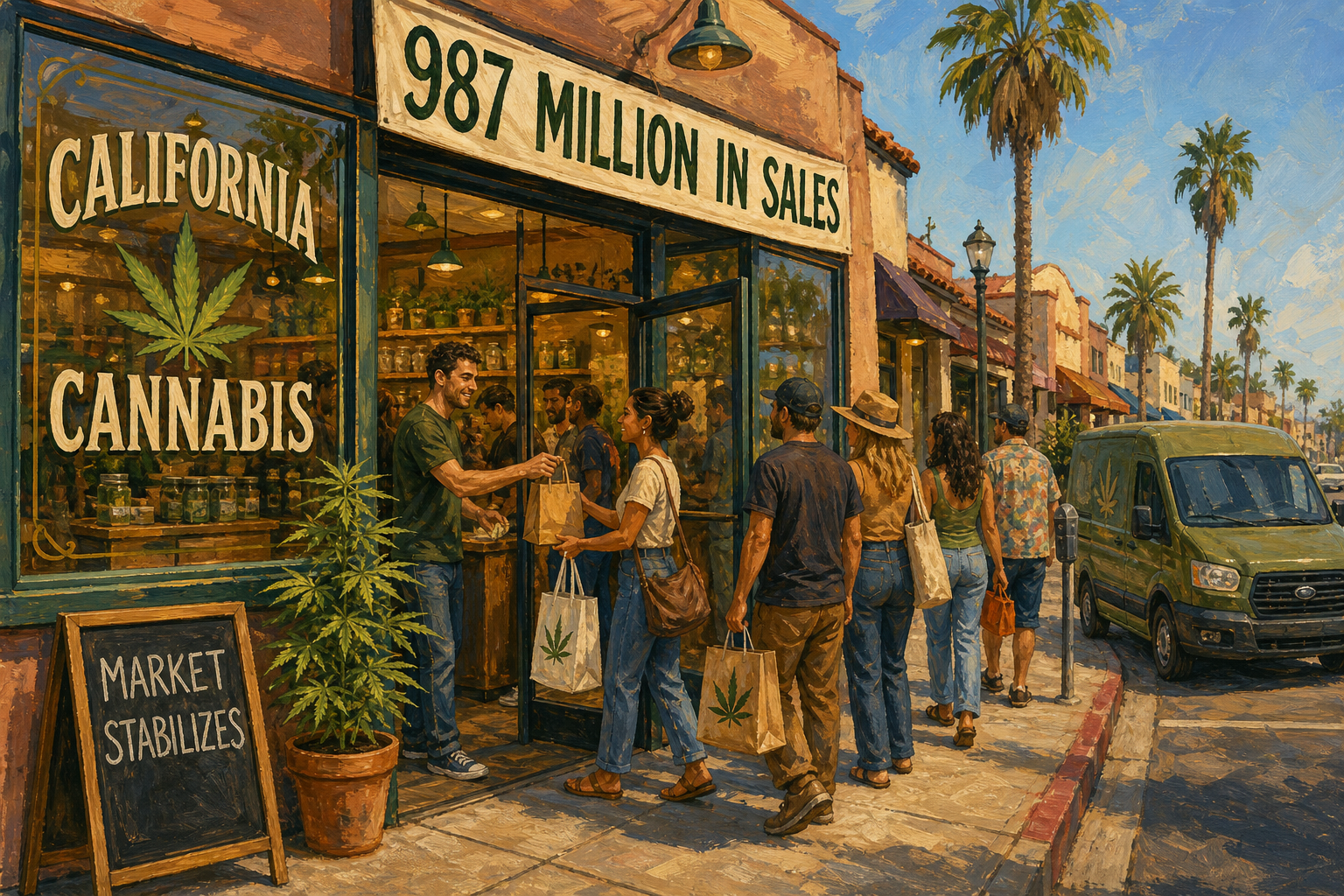
California cannabis stores reported $987 million in sales during the third quarter of 2026, according to data the California Department of Tax and Fee Administration released November 19. That figure is a slight increase over the $960.5 million recorded in the same quarter last year, which was recorded during the short-lived tax hike. In summer 2025 the state excise tax climbed from 15% to 19% under an automatic increase written into state law after lawmakers and Gov. Gavin Newsom did not reach a budget deal to stop it. That hike, which Newsom repealed under a bill he signed in September 2025, pushed annual sales down to just under $4 billion. Second-quarter sales in 2026 also edged past 2025, $1.013 billion to $1.006 billion, and total sales through the third quarter now stand at $2.965 billion, up about $20 million from the first three quarters of 2025.
California remains the country’s largest cannabis market, but price compression continues to let stores ring up more items while recording less revenue. Many operators say local taxes and fees on top of the state excise and sales taxes keep steering customers toward cheaper illicit alternatives, and Nithya Raman, the mayor-elect in Los Angeles, pledged during her campaign to rewrite a fee structure that LA operators called disastrous.
Source:
https://mjbizdaily.com/news/california-cannabis-sales-recovering-after-tax-hike-stumble/619278
📋 CALIFORNIA: DCC PROPOSES PERMANENT RULES TO SPLIT MEDICAL AND ADULT-USE LICENSES
The California Department of Cannabis Control published a notice of proposed rulemaking on October 30, designated DCC-2026-04-R (“Modifications to A and M Designation”), that would make permanent a change letting cannabis retailers separate their medical business from their adult-use business. The package formally adopts emergency regulations the department put in place on June 4. Under California law, every non-laboratory cannabis license must carry an adult-use (A) designation, a medicinal (M) designation, or both, and until the emergency rules there was no way to turn a combined license into two separate ones without withdrawing the original and filing two new applications. Since the emergency rules took effect, 95 licensed businesses have obtained separate adult-use and medicinal licenses for their existing premises. The push followed the federal order this spring moving state-licensed medical marijuana from Schedule I to Schedule III, which left adult-use cannabis still illegal under federal law. Under the proposed text, a retailer or microbusiness with a combined license could convert to an A-license and receive a new M-license, which can sit with a separate entity at the same premises if both share the same individual owners and designated responsible party, keep goods and records physically separate, and accept joint and several liability. DCC would review each request within five business days.
The department estimates the rules would affect about 1,600 licensed retailers and microbusinesses that hold both designations, roughly 97 percent of them small businesses, though taking part is voluntary. Written comments are due by December 14, and a virtual public hearing is set for December 15 at 10 a.m., with limited in-person seating at DCC’s Rancho Cordova hearing room. The proposal appeared the same day the Justice Department announced the DEA had issued its first federal registrations to more than 900 medical marijuana dispensaries across seven states, with California not among them.
📋 CALIFORNIA: 771 STATE APPLICANTS APPEAR ON DEA FEDERAL REGISTRATION LIST
The Drug Enforcement Administration issued its first federal registrations to more than 900 medical cannabis dispensaries across Alabama, Florida, Mississippi, South Dakota, Texas, Virginia and West Virginia, the Department of Justice announced in reporting published October 30. The Justice Department called it the first phase of implementing the April order that moved state-licensed medical marijuana and FDA-approved marijuana products from Schedule I to Schedule III. A DEA list of businesses that applied on time shows 6,983 applicant locations, including more than 4,000 dispensaries, more than 2,000 manufacturers and about 700 distributors. Oklahoma leads with 2,442 entries, followed by Florida with 812 and California with 771. The list identifies each location’s state and business type, but not the company behind it. Businesses DEA calls Timely Applicants have until November 29 to verify their trading partners and build what the agency calls compliant supply chains, collecting each partner’s DEA submission confirmation or certificate of registration and checking active state licenses.
None of this applies to adult-use cannabis, which remains in Schedule I while a separate DEA proceeding on broader rescheduling continues. State licensure alone does not automatically grant federal registration, and registered dispensaries become subject to federal requirements for security, recordkeeping, inventory controls and other safeguards governing the handling of controlled substances. For California businesses on the list, the federal process touches only the medical side of the market, so the state’s adult-use retail channel stays outside the registration framework for now.
Source:
https://hightimes.com/news/politics/dea-first-federal-registrations-medical-cannabis-dispensaries
The Bottom Line
November kept California’s cannabis market in motion on several fronts. The Ninth Circuit put the labor peace licensing question back before a federal court, Q3 store sales reached $987 million, and the DCC advanced permanent rules to split medical and adult-use licenses. On the federal side, 771 California applicants appeared on the DEA registration list, though that process reaches only the medical part of the state’s cannabis retail market.
📬 The CannDev Monthly Puff Newsletter
Stay ahead of the curve with our monthly cannabis retail market newsletter. New markets, regulatory changes, and expansion opportunities delivered to your inbox.