WA Monthly Puff: Washington Cannabis Retail Buffer Stays Put
Washington’s cannabis market saw regulators and local councils tighten the rules this November. The Washington cannabis retail buffer in Clearview held after the Snohomish County Council voted down a code change for a second shop, and the state Liquor and Cannabis Board advanced two separate proposals, one closing a five-store ownership loophole and another letting growers form cooperatives. A new study also put numbers on how local bans push buyers onto longer drives.
Top Headlines This Month
- 📋 Snohomish council rejects second Clearview cannabis shop
- 📋 State proposes rules to close five-store ownership loophole
- 📋 Cannabis board advances grower cooperative rules
- 📋 Study links local bans to longer dispensary drives
📋 SNOHOMISH COUNTY: COUNCIL REJECTS CODE CHANGE FOR SECOND CLEARVIEW CANNABIS SHOP
The Snohomish County Council voted down a code change on October 28 that would have allowed a second cannabis shop in Clearview, an unincorporated area about 10 miles southeast of Everett where more than 3,500 people live. Current rules bar retailers from opening within 10,000 feet (just under 2 miles) of one another in the Clearview Rural Commercial zone, and the proposed change would have lowered that buffer to 2,500 feet, matching Everett code. Council member Sam Low proposed an amendment that swapped the word 'marijuana' for 'cannabis' and stripped out all changes to the 10,000-foot buffer. The amendment passed 3-2, with Jared Mead, Nate Nehring and Low voting for it and Strom Peterson and Megan Dunn voting against. Patrick Gahan, who hoped to open a Hangar 420 store in Clearview, argued that keeping the location closed cost jobs, economic activity and tax revenue, while residents who have fought additional shops on their stretch of Highway 9 for more than 10 years pushed back. The commercial zone covers 115 acres split into two parts along the highway.
The vote leaves a July 18 injunction in place. Superior Court Judge Cindy Larsen had paused Hangar 420 from opening the Clearview shop while the county’s lawsuit against the business proceeds, and approving the buffer change would have lifted that injunction. The Clearview zone is the only 'local area of more intensive rural development,' or LAMIRD, in Snohomish County, a designation that limits commercial development to what serves the existing rural population, so the single-retailer limit stands for now. Gahan said he would keep gathering signatures and building support rather than give up.
📋 WASHINGTON: STATE PROPOSES RULES TO CLOSE FIVE STORE OWNERSHIP LOOPHOLE
The Washington State Liquor and Cannabis Board is moving forward with proposed rules to stop retail chains from circumventing the state’s five store ownership limit through shared branding, coordinated purchasing and management agreements. The board was scheduled to consider the proposal at its November 4 meeting, according to a regulatory packet spanning 91 pages. Washington law limits individuals and businesses to financial or ownership interests in no more than five marijuana retail licenses, but regulators say some companies have used intellectual property and management agreements to effectively run larger networks without technically holding additional licenses. The proposed regulations would clarify that financial interests extend beyond direct ownership to include shared branding, trade names, logos, websites, social media accounts, marketing campaigns, customer loyalty programs and coordinated purchasing. The rules would also prohibit preferential wholesale pricing that is not available to all licensed retailers statewide, bar exclusive agreements between processors and retailers, and classify white label and private label products as prohibited exclusivity arrangements when packaged with a retailer’s branding or created exclusively for a retailer. The changes implement Engrossed Substitute Senate Bill 5403, which took effect January 1, 2026.
The restrictions respond partly to complaints submitted to regulators in 2025 alleging that larger chains pressured processors to reduce prices and withhold products from competing businesses. Certain exceptions would remain, as consultants, vendors, service providers and employees working part time would not automatically be treated as owners. If the board authorized the proposal, a formal public comment period would begin, with a public hearing set for December 10 and final adoption possible as early as January 6, 2027, and the rules potentially taking effect February 6.
📋 WASHINGTON: CANNABIS BOARD ADVANCES RULES LETTING MARIJUANA GROWERS FORM COOPERATIVES
The Washington State Liquor and Cannabis Board voted to advance proposed rules that would allow licensed marijuana growers to form agricultural cooperatives. According to The Marijuana Herald (published November 4), the board moved the proposal forward to bring the state closer to implementing a law written to let producers work together, pool their efforts, reduce costs, and improve efficiency. The rules apply to licensed cultivators, giving them a formal path to coordinate as a cooperative rather than operating entirely on their own.
Because the measure is still at the proposed stage, growers cannot form these cooperatives until the board finalizes and adopts the rules. For Washington’s licensed cultivation base, the structure opens the door to shared resources and joint operations that lower the cost of supplying the state’s marijuana retail market.
📋 WASHINGTON: STUDY LINKS LOCAL BANS TO LONGER DISPENSARY DRIVE TIMES
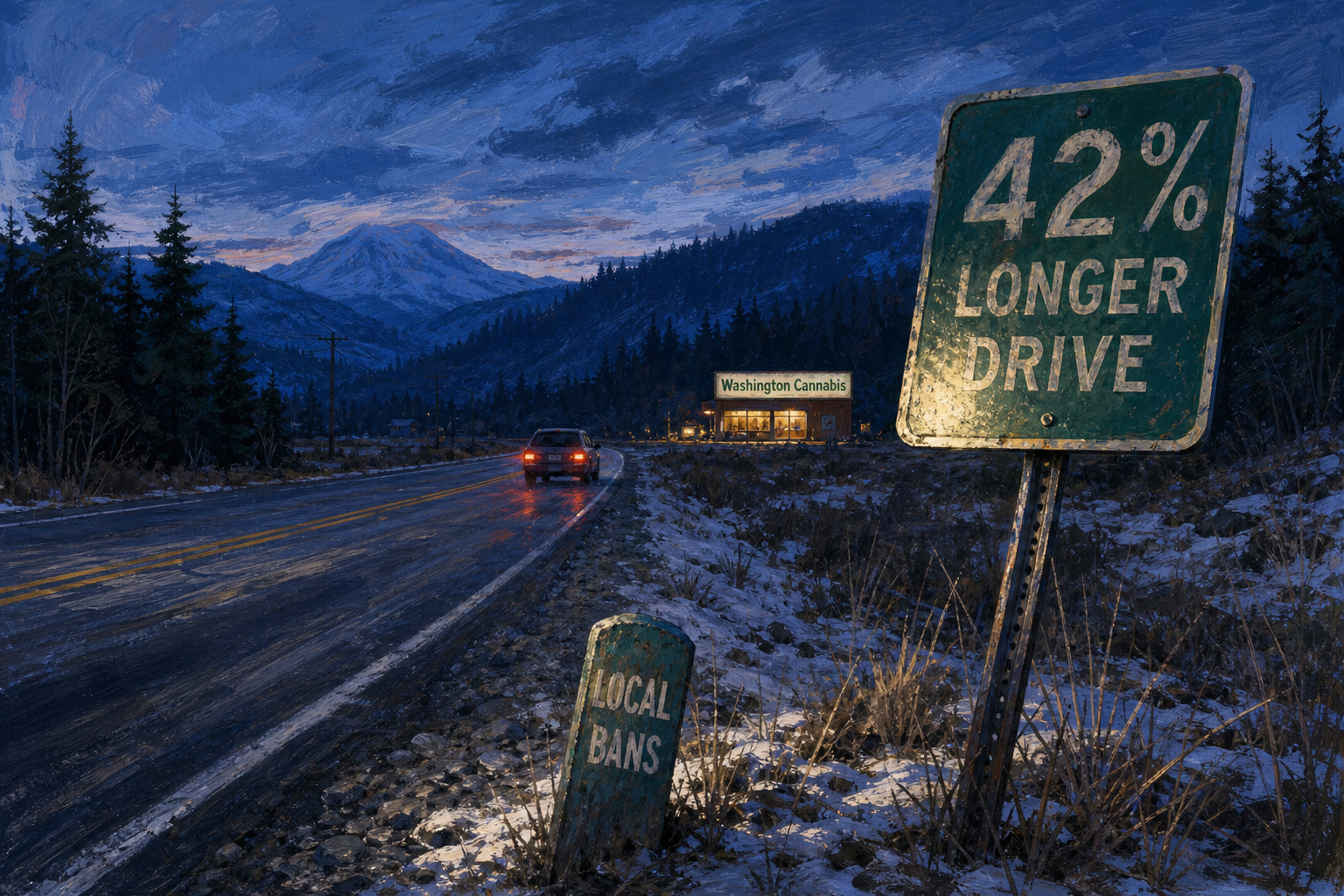
A study published October 23 found that local marijuana bans in Washington were associated with an additional 8.9 minutes of driving to reach the nearest legal marijuana retailer. Researchers reported that this added distance was equivalent to 42% of the state’s average minimum dispensary drive time. The finding quantifies how city and county decisions to prohibit retail within their borders translate into measurable travel burdens for consumers who have to leave their own jurisdictions to buy from a licensed store.
The research puts a specific figure on the gap between where marijuana is legal statewide and where it is actually available at retail. When nearby jurisdictions opt out, legal demand concentrates in the areas that allow dispensaries, which shapes where stores can viably locate and which populations have convenient access to the regulated market.
The Bottom Line
November brought a wave of regulatory activity to the Washington cannabis market. The Clearview retail buffer stayed in place, the Liquor and Cannabis Board moved on both the five-store ownership limit and grower cooperatives, and fresh research tied local bans to an extra 8.9 minutes of driving to the nearest legal store.
📬 The CannDev Monthly Puff Newsletter
Stay ahead of the curve with our monthly cannabis retail market newsletter. New markets, regulatory changes, and expansion opportunities delivered to your inbox.